
Home » Posts tagged 'Sydney'
Tag Archives: Sydney
William Ansdell Leech (1842-1895) and the Fresh Air League
On 25 September 1890,[1] in his parish of Bong Bong in the Southern Highlands of NSW, the Rev William Ansdell Leech, an Anglican clergyman, formed a Ministering Children’s League (MCL) group from which the NSW Fresh Air League (FAL) would arise. Initially, the activity that gave rise to the FAL was Leech’s particular way of fulfilling the ideals of the MCL. It soon became apparent that providing holiday accommodation for poor children and families in a healthy mountainous environment was a ministry deserving of its own name.
William Ansdell Leech (1842-1895) was the eldest son of Rev John Leech, MA, of Cloonconra County Mayo, Ireland, and Mary nee Darley, daughter of William Darley of St John’s County Dublin.[2] Leech matriculated to Cambridge University in Lent of 1865 and was a Scholar at the University from 1866. He was admitted to Lincoln’s Inn on 6 November 1866, gained a BA in 1868, and was called to the Bar on 10 June 1870 as a Barrister-at-Law. Leech went on to be ordained deacon by the Bishop of Wellington, New Zealand (and appointed a curate of Palmerston North) in 1883, before being priested by the Bishop of Bathurst in St Andrew’s Cathedral, Sydney, in December of that same year.[3]
Travelling to New Zealand on the Dallam Tower
Leech’s first attempt to sail to New Zealand was not without incident for he travelled aboard the Dallam Tower which had left London on 11 May 1873, bound for Dunedin, New Zealand.[4] On 14 July, the ship met a ‘fearful hurricane’ and was dis-masted in latitude 46 degrees south and 70 degrees east. The vessel was at the mercy of the storm for some 14 hours after which the hurricane abated. Without a mast the ship was helpless, but after 11 days the Cape Clear, a cargo ship, came to their assistance and took off some of the Dallam Tower’s passengers who were in ‘a most forlorn and destitute condition. Their money, letters of credit and introduction, clothing and other necessaries gone.’[5] As one passenger remarked, they were fortunate not to have lost their lives:
But it was a mysterious Providence that sent the Cape Clear to our help. Had it not been for the distressing loss of two of their number we should never have seen her. One of the apprentices on the previous day had fallen from the rigging, and another in a noble but hopeless attempt to save him, went overboard after him. The ship delayed her course for several hours, while a boat was sent in a vain search for these poor fellows. Thus it was that she came up with us at the dawn of morning, otherwise they would have passed us in the night without seeing us.[6]
(more…)The Model Lodging House Company of Sydney (Limited)
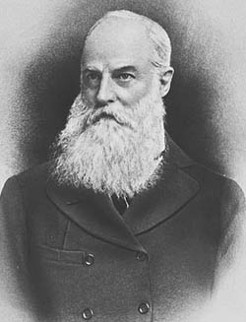
Henry Burton Bradley (NSW State Library)
In the 1870s, the development of housing for working class single men was an issue that many thought needed to be addressed. To do this a group of philanthropically minded men decided to form a limited liability company with shareholders to address the matter. This charity was different to most and was not, strictly speaking, a charity as those who benefited had to pay for the benefit they received and the shareholders were to receive a dividend from their investment. The project was called the Model Lodging House Company of Sydney (Limited) (MLHL). There was already a Model Lodging House in Melbourne which commenced in 1871,[1] but it proved more difficult to commence one in Sydney. The purpose of the company was ‘to furnish in Sydney accommodation for the poor of the hard-working classes, who have no homes of their own, a shelter by night, both healthful and decent, at a cost which will make the institution self-supporting, and which may in the course of years pay a moderate dividend to the shareholders.’[2] The principle of the MLH was that the working man did not need charity in the narrow sense of the term and so they were determined to make the MLH pay. They did not intend to disparage the broad principle of charity, but they wished to avoid the ‘eleemosynary [Latin for charity] element’ in an institution that should stand alone.[3]
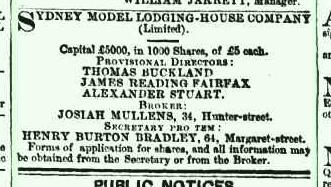
Advertisement for shares in the Model Lodging House, Sydney
First efforts to commence a MLHL were made in 1874 by Alfred Stephen but were unsuccessful.[4] Henry Burton Bradley (1815-1894),[5] Secretary of the Health Society of New South Wales (HSNSW) again raised the matter in 1876[6] and under the banner of the HSNSW continued to pursue the matter approaching Josiah Mullens[7] to enlist his support for such a venture.[8] In August of 1877, the HSNSW agreed to attempt to float a company in order to raise the capital to build a lodging house initially to accommodate 100[9] with FH Reuss (Snr) giving his services as an architect to design the building. In February 1878, Bradley, ever positive and hopeful, was reported as saying that commencement of the building was to soon begin.[10] The company was formed with a capital of £5,000, 1000 shares of £5 each, its directors being Thomas Buckland, James Reading Fairfax, Alexander Stuart with Josiah Mullens the broker, Henry Burton Bradley the Secretary[11] and John Sidney was the collector.[12] (more…)
 Philanthropists and Philanthropy