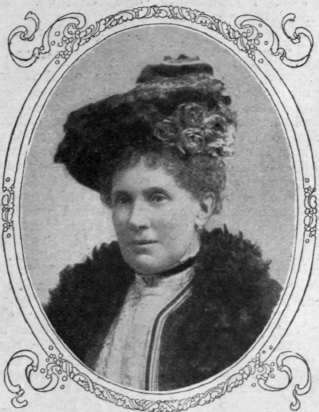
The Ministering Children’s League (MCL) was a British organisation founded in February 1885 by the Countess of Meath in her house at 83 Lancaster Gate, London.[1] In developing the MCL she was assisted by the Rev C J Ridgeway in whose parish of Christ Church Lancaster Gate the first group began.[2] The Countess was Mary Jane Brabazon (née Maitland) (1847-1918) and in January 1868 she married Reginald Brabazon who became the 12th Earl of Meath in May 1887.[3] Her inspiration in founding the MCL came from a book she had read as a child. Written by Maria Louise Charlesworth, it was titled Ministering Children and encouraged children to a lifetime of service to others.[4]
Maria Louisa Charlesworth (1819-1880) was the daughter of Elizabeth Charlesworth (née Beddome) (1783-1869) and the Reverend John Charlesworth (1782-1864), an evangelical clergyman who was Rector of Flowton, Suffolk, when Maria was born. He later became Rector of St Mildred’s, Bread Street, a London parish where Maria lived with him in the Rectory at St Nicholas Olave. A visitor to the poor in her father’s parishes from a young age, Maria drew on these experiences for her most popular book, the fictionalised Ministering Children (1854). Ministering Children sold over 300,000 copies during her lifetime and was designed to teach children, by example, to be kind to the poor. It was especially popular as a ‘Reward Book’ for Sunday School prizes.[5]
Charlesworth wrote in the book’s preface:
Ministering Children by Maria Charlesworth
… it is necessary that the talent of money be not suffered to assume any undue supremacy in the service of benevolence. Let children be trained, and taught, and led aright, and they will not be slow to learn that they possess a personal influence everywhere; that the first principles of Divine Truth acquired by them, are a means of communicating to others present comfort and eternal happiness; and that the heart of Love is the only spring that can effectually govern and direct the hand of Charity.[6]
The MCL was not the only philanthropic activity of the Countess for she was a significant philanthropist. The Countess was responsible for the formation of the Brabazon Employment Society, established to provide occupation for those in Workhouse or Infirmary wards; the Meath Home of Comfort for Epileptic Women; Brabazon Home of Comfort for members of the Girl’s Friendly Society; the Brabazon House for Aged Ladies (Dublin); Brabazon and Hopkinson House which provided cheap accommodation for women in London; the Workhouse Attendants Society and the Workhouse and Hospitals Concert Society.[7] She also took an active role in the formation of the Girl’s Friendly Society (GFS) in England and Scotland.
It was in connection with the GFS that a second source of inspiration for forming the MCL arose. Lady Meath, while carrying out visitation in the East End of London in connection with the GFS,
… became aware of the difficulty of obtaining a good supply of voluntary philanthropic workers amongst the poor, and she asked herself the question, ‘Why is this? Why, when there are thousands of unemployed young men and women possessed of leisure, social position, health, education, talents, and money, should it be so difficult to replace a vacancy …?’[8]
Her conclusion was that the problem arose not so much from want of heart as from want of training:
… it seems to be taken for granted that any person can work for God without training, though no one would for a moment think of neglecting to train his sons for the business of life. The habit of usefulness in the world requires cultivation as well as any other; it is grossly neglected … If children be taught to consider others, and to think how they can be kind to those around them, the love of their fellow men and women will take such hold of their hearts that it will become almost a second nature to put oneself in the background and to live for others. Hence the Ministering Children’s League, which was started …[9]
MCL was non-sectarian and received the ready sympathy of representatives of all shades of religious belief.
Cardinal Manning wrote – “It invites the two things God loves best – children and charity. I join with all my heart in the hope that God may abundantly bless your work.” The Archbishop of York “highly approves its aim and work,” and the Right Rev Dr Moorhouse finds it “a most excellent association.” In the same way as the league has won the approval of Roman Catholic and Anglican, so has it won the approval of representatives of the Wesleyan, Baptist, Presbyterian, Jewish, and other communions.[10]
It is not hard to appreciate why parents could see value in such a movement for their children so it is no surprise that adult support saw the MCL quickly established in England, the United States and Canada and was soon present in Australia. By 1892, the MCL had 20,000 members in England, 15,000 in the United States and 5,000 in the rest of the English-speaking world.[11] The MCL had an optimistic view of the ability of human nature to overcome its self-centeredness. It is clear, especially so if the MCL received Jewish approval, that it was a sanctifying movement rather than an evangelistic movement. Its aim was not the conversion of a child, but the encouragement for children to behave in a ‘holy’ way. As there was no strong centralized control exercised, it is probable that each group reflected the character and commitments of those who were its local leaders. It ‘had only one rule, viz, to try to do at least one kind deed every day, and to be loving, kind, and useful to others’.[12] The objects of the MCL were:
To promote kindness, unselfishness and the habit of usefulness amongst children, and to create in their minds an earnest desire to help the needy and suffering.
2. To aid the necessities of the poor by supplying them with warm clothing, comforts etc’[13]
The Countess of Meath wrote:
The object of our education ought to be to train up a child to become a devoted Christian, not one who merely reads his Bible occasionally and attends a certain number of church services, but who brings his Christianity into daily life, trying humbly to follow in the footsteps of Him who went about doing good. Such a man can scarcely fail to be useful to hundreds of his fellow-creatures; he is happy himself and he makes others so.[14]
A branch of the MCL was first formed in colonial Australia in Adelaide by Mrs William Storrie. She had been absent from the colony in England for five years and on her return, sometime after June 1887, she read some literature on the league that she had been given in England by a young girl.[15] Mrs Storrie was so impressed by what she read that she commenced a group and branches soon followed in other colonies: in Sydney (1888), Melbourne and Geelong (1890), Perth (1891)[16] and then, encouraged by the visit of the Countess to Australia in 1892, groups were formed in Hobart (1892)[17] and Brisbane (1892).[18]
It would appear that independently, and unaware of the Adelaide group, All Saints Petersham and St Paul’s Burwood, both Church of England churches, were the first NSW branches formed in 1888 and were followed by Woollarah in 1889.[19] The Rev and Mrs Charles Baber were the key figures at Petersham and the Rev and Mrs Arthur Bartlett were the key figures in the adjacent parish of Burwood. By 1890, Lady Darley was the organizing secretary and Lady Carrington the patroness of the NSW MCL and, with a reorganisation in 1901, Miss Calder became the organizing secretary of the MCL for Australia.[20] The movement became the strongest in NSW and was quickly adopted.
The MCL was not just a meeting for children for they needed to be helped and guided in their work and ministering by their parents and others. So the help of ‘grown-up people’ was sought and they were invited to become associates of the MCL, and to take their part in training all the ‘little ones’ to become ministering children. The names of all who join were entered by the branch secretary into a book with their address, and whether associates or members. The secretary was to send out notices of meetings which were to be held at regular intervals, quarterly or half-yearly, that the interest of the children might be sustained, and that all members and associates might become acquainted.
When some persons were willing to help with monetary donations, and others with the donation of clothes, these were received by the secretary. In addition to the secretary, a president, treasurer, and assistant treasurer were chosen as office bearers so that work was not left to one person. All donations, or monies earned from sale of work by children and adults, were to be presented at the meetings for decision as to where the funds should be allocated. Common causes supported were cots in a district or city hospital, the support of orphans or poor children by the provision of books, illustrated papers, and toys. These latter items were commonly purchased and donated or came from the MCL children who were encouraged to contribute from their own toys or funds in order to give to others.
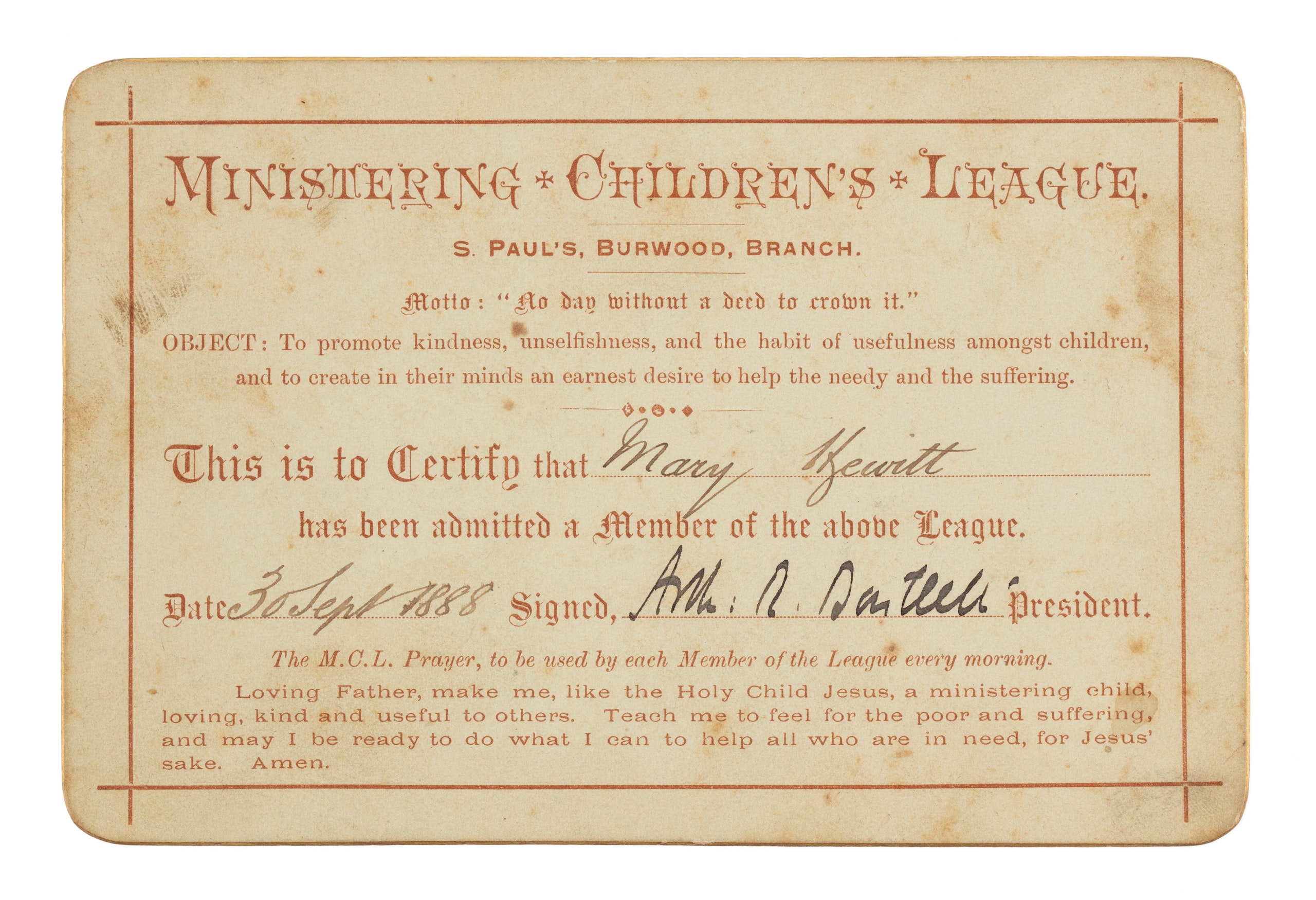
Ministering Children’s League membership card St Paul’s, Burwood
A membership card from St Paul’s Burwood, dated September 1888, exists and commits members to uphold the Motto ‘No day without a deed to crown it.’ This card also has a MCL prayer which was to be prayed daily:
Loving Father, make me, like the Holy Child Jesus, a ministering child, loving, kind and useful to others. Teach me to feel for the poor and suffering and may I be ready to do what I can to help all who are in need, for Jesus’ sake. Amen.[21]
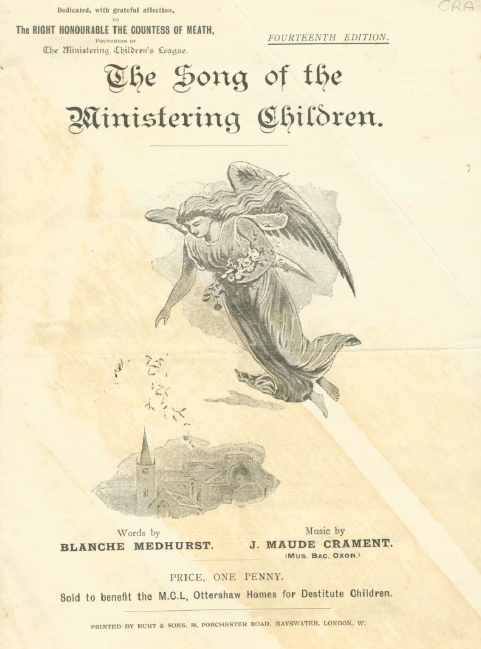
There was also a hymn written in 1888 by Blanche Medhurst to be sung at MCL meetings with words which appropriately captured the philosophy of the movement:
By the time of Lady Meath’s visit to Sydney in 1892, there were some 20 groups in NSW[23] and these included: St John’s Parramatta 1889; All Saint’s Bathurst 1890; Ryde 1890; Bong Bong 1890; Randwick 1890; Katoomba 1891; Canargroo 1891; Camden St John’s 1891; St Matthews Windsor 1891; Goulburn 1891; Sutton Forest 1892; Moss Vale 1892 and Bowral 1892.[24] Over time, various properties were acquired by MCLs in some other states. The Victorian MCL, for example, purchased a cliff top property in Queenscliff and founded the convalescent home, Cottage By The Sea[25] and in 1897, a Convalescent Home was opened by the MCL at Cottesloe in Western Australia.
After the departure for England in January 1909 of Lady Darley, the MCL’s most enthusiastic supporter, the decline in interest in the MCL became increasingly apparent.[26] The Sydney Morning Herald expressed disappointment at the lack of local interest. It noted that the MCL was now present in Russia and Egypt as well as England, Canada and Australia. In England, it was said that all was going well and that the membership, predominantly wealthy children, were upholding the ideals of the MCL by sharing,
… but in Australia the more wealthy children seem to have little time to devote to others, and the majority of ministering children here are of a poorer class than in other countries- not the very poor, of course, but children who have plenty of opportunities in their daily life of practising unselfishness and thought for others. This is a pity, for two reasons. Their efforts cannot be as effective, because they are hampered by want of means, and at the same time the richer and more pampered children lose that happiness which comes from doing something for somebody else.[27]
The article also sought to refute the view held, it said by many, that the MCL encouraged priggishness. Perhaps it was this growing perception, and the recent difficult financial times, that induced the decline in the MCL’s popularity. The movement continued to decline in NSW except in the Southern Highlands where its connection with the Fresh Air League maintained the involvement of many female philanthropists. By the end of World War 2, most groups had ceased to function and after the War the respite properties were the few remnants of the MCL that remained. In 1957, the MCL was disbanded.[28]
During its lifetime the MCL attracted support from large numbers of people including leading NSW female philanthropists such as Lady Darley, Mrs Wilhelmina Stanger-Leaves, Mrs Ada Docker and Mrs Ann Goodlet. Its success, however, was due to the efforts of the many parents, particularly the mothers, who saw in the MCL an organization that would benefit their children.
Paul F Cooper
Research Fellow
Christ College, Sydney
The appropriate way to cite this article is as follows:
Paul F Cooper. The Ministering Children’s League Philanthropy and Philanthropists in Australian Colonial History, 24 August 2023, available at colonialgivers.com/2023/08/24/the-ministering-childrens-league
[1] This street address was to become the head office of the movement.
[2]Queenslander (Brisbane, Qld), 21 January 1888, 94; West Australian (Perth, WA), 28 August 1911, 9. Charles John Ridgeway (1841-1927) was an English churchman, the Bishop of Chichester from 1908 to 1919.
[11]South Australian Chronicle (Adelaide, SA), 2 April 1892, 7.
[12] R. B. Meath (Ed) The Diaries of Mary Countess of Meath, 80.
[13]Daily Telegraph (Sydney, NSW), 14 December 1889, 10.
[14]The Parents’ Review A Monthly Magazine of Home-Training and Culture Edited by Charlotte Mason; ‘The Ministering Children’s League’ Countess of Meath. Volume 2, 1891/92, 49.
[15]South Australian Chronicle (Adelaide, SA), 2 April 1892, 7; Evening Journal (Adelaide, SA), 23 Dec 1889, 3.
The Argus (Melbourne, Vic), 24 Mar 1892, 5; The Brisbane Courier (Qld), 4 Dec 1893, 5.
[19] It was mentioned in a meeting in 1889 to promote the formation of MCL branches that they had been in existence ‘for some time’. Daily Telegraph (Sydney, NSW), 14 December 1889, 10. The first group formed at a Presbyterian Church was at St Peter’s, North Sydney. SMH, 4 Nov 1894, 6.
Certificate and letter, part of collection, paper, addressed to Miss Hewitt, sent by W F Capebread, Strathfield, New South Wales, Australia,1888-1900. Object No. 87/943 Certificate, ministering children’s league & letter, 1888-1890 Signed by Arthur A Bartlett the vicar of St Paul’s Burwood
[22]The Scrutineer (Moss Vale, NSW), 23 Feb 1892, 2. https://nla.gov.au:443/tarkine/nla.obj-165930042
[24]The Cumberland Argus and Fruitgrowers Advocate (Parramatta, NSW), 28 Dec 1889, 2; SMH, 11 June 1890, 3; SMH, 13 Aug 1890, 9; Australian Town and Country Journal (Sydney, NSW), 4 Oct 1890, 16; SMH, 26 Dec 1890, 5; 4 Mar 1891, 5; Bathurst Free Press and Mining Journal (NSW), 20 Apr 1891, 2; Australian Town and Country Journal (Sydney, NSW ), 9 May 1891, 11; The Cumberland Mercury (Parramatta, NSW, 20 May 1891, 2; Goulburn Evening Penny Post (NSW), 1 Dec 1891, 2; The Scrutineer (Moss Vale, NSW), 26 Jan 1892, 2; 2 Feb 1892, 2;. The Scrutineer and Berrima District Press (NSW), 17 Dec 1892, 5.


 Philanthropists and Philanthropy