
Home » 2021
Yearly Archives: 2021
John Mills (1829-1880) wholesale grocer and governance philanthropist
John Mills was born in 1829 in Tidworth, Wiltshire, to James Mills, a farmer and his wife Charlotte nee Mackrell.[1] John was a cigar manufacturer[2] but was listed as a clerk when he came to the colony of Victoria. He arrived on the Nepaul at Port Philip Bay on 20 October 1852, while on 24 November 1852, Emily Stidolph (20 June 1826-27 June 1887) arrived on the Chalmers. John and Emily were married on 14 January 1853 at the Lonsdale Street Congregational Church[3] and were to have eight children: William Mackrell (1854-1931), Caroline Eliza (1856-1914), Stephen (1857-1948),[4] Emily (1862-1940),[5] Lucie Ellen (1863-1948),[6] Arthur John (1865-1916),[7] Evelyn Clara (1867-1954)[8] and Sylvia Hannah (1869-1927).[9]The Mills soon moved to Sydney and lived firstly at 11 Botany Street and then at 78 Albion Street, Surry Hills, from at least 1862 until 1872 when they moved out of the city to the semi-rural setting of ‘Elston Villa’, Alt Street, Ashfield.[10] In 1879, the impressive ‘Casiphia’ was constructed in Julia Street, Ashfield, and was occupied by the family.[11]
John Mills died in 1880 at the age of 51,[12] leaving Emily with eight sons and daughters aged between 11 and 26 years. He was buried in the cemetery adjacent to the Dobroyde Presbyterian Church.[13] Emily moved from their home ‘Casiphia’[14] in Ashfield to ‘Aurelia’ in Liverpool Road, Croydon, where she died in 1887 aged 61.[15]
The Wholesale Grocer
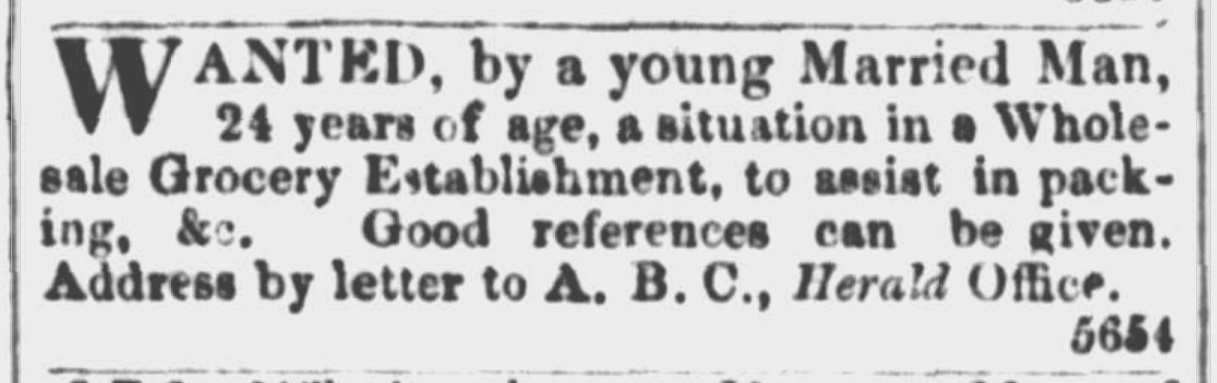
When and how John came to be employed in Sydney is unknown. He may have placed an advertisement like the one below for it fits him well; he was at that time 24 years old, married, and he did end up working in the grocery business.[16] It is known that he was in Sydney by June 1853[17] but not if he was employed in the grocery trade by that time.
The first ‘grocery’ reference to John Mills is in December 1854 in Sydney where he was, as a grocer’s assistant, in the employ of William Terry, Wholesale Grocer. John, along with 34 other grocer’s assistants, had petitioned their employers to rationalize the business hours that they were expected to keep.
Their argument was that
… we need not enumerate the many advantages that would be derived by us, in allowing more time for moral improvement and healthful recreation, and after carefully studying our employers,[sic] interest and making that our great desideratum, we must respectfully submit for their approval the following proposal: …
Their proposal was to restrict business hours so ‘That business be closed every night at seven o’clock, except Saturday, on which night close at ten o’clock. To commence January 1st, 1855’.[18]
John worked for William Terrey as his shop man and he was conscientious. One incident in his life as a shopkeeper made the newspaper in 1855. On entering the shop, Mills had noticed a boy leaning over the counter with his hand in the till. As soon as he saw Mills he took off as did his companion cockatoo who was meant to give a warning. Mills gave chase and finally caught them both. The young thief admitted to taking 10 shillings and offered to return it on condition he be let go. This was not agreed to but the 10 shillings was handed over anyway and off to the Police he was taken. On searching him, a florin from the shop was found. As there was not enough evidence to convict the cockatoo he was sent home. The young thief, however, since it was his fifth offence in less than a year, was given three months jail; he was ten years old.[19]
(more…)George Collison Tuting (1814-1892)
an aspiring but ordinary nineteenth-century colonist
George Collison Tuting was not an outstanding figure in nineteenth-century NSW. Coming to the colony he hoped to better himself and his family in the drapery business which was a trade he knew well. On arrival he was socially well connected through marriage to the Farmer family (Farmers & Co). He was welcomed into the Pitt Street Congregational Church’s merchant circle (including G A Lloyd, Alfred Fairfax, David Jones) and while he had great aspirations he failed to convert them into business success. His early philanthropic endeavours were quickly extinguished by his failure in business; bankruptcy does not enhance one’s ability to be philanthropic. In the latter phase of his life, having obtained a certain level of financial stability, he gave of his time to help organize various philanthropic activities mostly promoting spiritual engagement.
Tuting was born in Beverley, Yorkshire, England, in January 1814 and was the son of Jeremiah Tuting, variously a cordwainer (shoemaker) and sexton of St Marys’ Church, Beverley, and Sarah Collison.[1] In 1841, George married Eliza Bolton (1817-1847) and they had 5 children: William Collison (1841-1918), George Bolton (1843-1843), Eliza Bolton Kent (1844-1883), Emily Sarah Parsons (1846-1924) and Henry Gutteridge (1847-1847). Eliza died in March 1847[2] and on 9 February 1848, George married Mary Petford nee Farmer (1804-1868), the widow of Jason Petford, a draper in Brierley Hill. Mary and Jason, had married in 1827[3] and had two daughters: Mary (1834-1858) and Amelia (1843–1928).
The Tuting family left England 8 November 1849, on the Prince of Wales and arrived in Sydney on 21 February 1850. The family group consisted of George and his wife Mary and George’s son William, his daughters Eliza and Emily, his nephew Thomas Shires Tuting together with Mary’s two daughters, Mary and Amelia.[4]
In England
George was a draper and his first shop was in the Market Place, Beverley, and while it is unknown when he began business, the first evidence of its existing is from 10 April 1840 when he sought to commend his goods to the public through the distribution of printed hand bills.[5] He was a religious man who, when advertising for staff, made a point of indicating that ‘a man of piety will be preferred’[6] and when seeking an apprentice gave the assurance that his ‘Moral and Religious training will be strictly attended to, as well as receiving a thorough knowledge of the Business.’[7] He was, as a churchman, a Congregationalist attending the Independent Chapel, Beverley, and later at Brierley Hill.[8]
It would appear that George was interested in missions, financially supporting a young Indian man from 1846-1849 so that he could undergo training for ministry at Bangalore, India.[9] He also gave money to a Medical Institution[10] and towards the building of a Mission College in Hong Kong.[11] The Missionary Magazine and Chronicle, a publication mostly concentrating on the work of the London Missionary Society, was itself largely supported by Independent Churches. That his financial support of missions was recorded in this publication is consistent with his churchmanship being congregational.
(more…)
Bush Missionary Society – the early years up to World War 1
In 1861, the Queanbeyan-based newspaper ‘The Golden Age’ reported a case which it regarded as one of ‘rank heathenism’ and ‘an instance of the most lamentable ignorance it is possible to conceive of, as existing in a professedly Christian country’.[1] The ‘rank heathenism’ and ‘lamentable ignorance’ concerned a 12-year-old boy named Hobson and his lack of even a basic civilising experience of school and church or an understanding of the Christian faith. He was to testify in the Small Debts Court, but before he was sworn in to give evidence the Police Magistrate asked him a few questions:
PM How old are you?
Boy Don’t know.
PM Have you been to school?
Boy No.
PM Ever been to church?
Boy No.
PM Do you say any prayers?
Boy No.
PM Ever heard of God?
Boy No.
PM Ever heard of heaven or hell?
Boy No. [and after some hesitation] Yes, I think I have.
PM What people go to heaven when they die?
Boy Bad people.
The newspaper then commented on the situation and suggested a remedy:
Who the parents of the boy are, we know not; but such a specimen of rank heathenism we never heard of in a so-called Christian country. We draw the attention of the committee of the Bush Missionary Society to this case.[2]
The isolation of the ‘bush’ in colonial Australia meant that there were many, like young Hobson, who were never exposed to the Christian message, worship and prayer and were thereby ignorant of its precepts; the problem was recognised, but it was difficult to address. An attempt, however, was being made to address this lack of Christian ministry through the distribution of bibles and religious literature by colporteurs, and it was to this ministry of the Bush Missionary Society (BMS) that the Queanbeyan newspaper ‘The Golden Age’ looked in order to address the problem.
The BMS was, however, not the first in the colony of NSW to seek to deal with the issue of the spiritual neglect of the bush through the use of colporteurs. This honour belongs to James Robinson, colporteur with the Bible Society, who was the first to provide a ministry of bible distribution to the sparsely populated rural districts. In 1852, Robinson began his work in ‘the bush’ and in his helpful article Gladwin says that:
Robinson’s journeys were the first of many undertaken by dozens of colporteurs—across the Australian continent—on behalf of Australian Bible Society agencies during the second half of the nineteenth century. They provided important pastoral and evangelistic ministry to sparsely populated rural districts in the decades before the creation of dedicated ministries such as the Anglican Bush Brotherhoods (1897–1920) and the evangelical Anglican Bush Church Aid Society (BCA, founded 1919).[3]
Well before the commencement of the Anglican bush ministries that Gladwin mentions, and only a few years after the commencement of the work of the Bible Society, the ministry of the non-denominational Juvenile Missionary Society (JMS), later known as the New South Wales Bush Missionary Society (BMS), was inaugurated.[4]
(more…)
More light on the founders of The House of the Good Shepherd
‘… by a few zealous ladies’
The precise origin of ‘The House of the Good Shepherd’ [HGS] in Sydney as a Catholic refuge for women and who was involved in its commencement, is a little uncertain. The various accounts that are given in an attempt to recall its commencement agree in the main but differ in the detail. New information, however, has come to light which would suggest, as this paper will argue, that some adjustment to the accepted narrative of events and persons involved needs to take place.
Simply put, the Catholic tradition[1] on the origin of HGS that has come down to us is that:
On a Sydney street in 1848, Father Farrelly of St Benedict’s Mission met a woman who was tired of life as a prostitute and begged him to find her a place where she could rest and rescue her soul. Farrelly placed her in the care of Mrs Blake, a Catholic laywoman, and when six more women asked for assistance, Polding instructed Farrelly to rent a house in Campbell Street. Mrs Blake looked after these women in the rented house[2] and, while the establishment was under her control, the Sisters of Charity visited to instruct the residents in the elementary tenets of their religion.[3] Archbishop Polding was anxious to make some permanent arrangement for the increasing numbers who were seeking shelter so he together with the Sisters of Charity established the Magdalen House in 1848,[4] which was soon after renamed ‘The House of the Good Shepherd’.[5]
(more…)Thomas Bately Rolin (1827-1899) Governance Philanthropist
Thomas Bately Rolin was born in King’s Lynn, Norfolk, England, on 4 September 1827 to Daniel Rolin (a shoemaker) and Ann Bately.[1] He was the youngest son of a family of at least six children. Leaving England in January 1854, he arrived in Melbourne on board the Croesus on 9 April 1854.[2] He remained in Victoria for eight months and then, in December 1854, he came to Sydney aboard the Governor General.[3]
In Sydney in May 1857, he married Louisa Jones (1835-1872)[4] the London-born third daughter of Thomas Jones (1796-1879)[5] and Elizabeth nee Smith (1798-1861).[6] Thomas, who was the brother of David Jones of David Jones & Co,[7] was a ‘broker’ or ‘commission agent’ and appears to have arrived in the colony of NSW in 1836.[8] Very little is known about Louisa’s parents or herself except that she had six children with Thomas Rolin: Minnie (1858-1899),[9] Tom (1863-1927),[10] Mildred (1865-1888),[11] unnamed male child (1867),[12] Gertrude (1868-1918)[13] and Frederick Lynne (1870-1950).[14] Thomas and Louisa settled in “Forest Lodge” on the corner of Pitt and Redfern Streets, Redfern, living there at least until 1871[15] when they moved to Burwood. It was here that Louisa died[16] in 1872 leaving Thomas, who never remarried, with children aged 14, 9, 7, 4, and 2. In 1880, Thomas took up residence in Redmyre Road, Strathfield, where he remained until his death on 26 June 1899.[17]
Thomas came to Australia in because of a business partnership he had with his older brother William Salmon Rolin (b 1821). William was a joiner by trade but had an entrepreneurial flair and became a property developer. As such, in 1848 he employed some 35 men on his building of houses and in renovating the Framingham Almshouses.[18] It would appear that he and Thomas formed a partnership as ‘Ship Builders and Shipwrights’ in King’s Lynn.[19] By October 1854, however, the partnership was bankrupt with debts said to be in excess of £20,000 ($1.6 M) with no assets available to offset this sum. William absconded to the United States of America where he took out citizenship,[20] whereas of Thomas, it was said:
About nine months since Mr. T. B. Rolin left England for the purpose of looking after the affairs of the partnership. It was no doubt necessary for him to do so, as the bankrupts were owners of vessels several of which were at Australia … Now the probability was, that Mr. T. B. Rolin knew nothing of the bankruptcy … it was probable that he did not know the firm was insolvent at the time he left England.[21]
In view of this, William Rolin was declared outlawed, but T B Rolin had his examination adjourned ‘sine die’ to allow him the opportunity to communicate with his assignees.[22] T B Rolin, however, never returned to England and the matter was never resumed. Whether Thomas’ absence in the colony was fortuitous or by design is unknown. That it was fortuitous is supported by it being publically stated that Thomas had not planned to remain in the colony of NSW being ‘temporarily in the colony’.[23] Probably, when he learned of the bankruptcy of Rolin and Rolin shipbuilders, it was a prudent if not an altogether ethical course of action. No doubt he said nothing, for someone who was a known bankrupt and in debt to creditors for such a large sum would find it difficult to build a future. This situation also explains why, later in life, when successful and prosperous, he did not return to England for a visit as so many other colonists had done. Whereas England now offered Thomas only difficulties, Australia was to prove to be an opportunity for advancement and for a second chance to build a successful, respectable and prosperous life. Given that his chosen profession of advancement was the law, being a bankrupt would not be an asset in assisting him to become a qualified solicitor.
(more…) Philanthropists and Philanthropy