
Home » 2020
Yearly Archives: 2020
Andrew Bell Armstrong (1811-1872)
Founder of the Sunday Morning Breakfast for the Poor
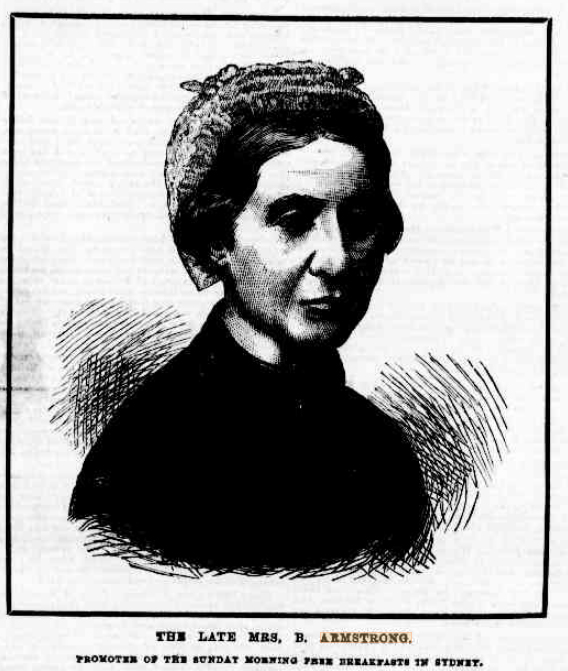
Andrew Bell Armstrong was born in Ireland around 1811 and died in Sydney on 17 June 1872, at 61 years of age.[1] Andrew married Barbara Iredale on 20 July 1844 in Sydney[2] and they were to have three children: Mary (b 1846), Thomas (b 1849) and John (b 1851). Barbara was to prove to be a willing partner in Andrew’s philanthropic efforts. Barbara Iredale was 28 years old on her arrival in the colony in 1842. She came with her mother and father, and she had with her a daughter, Sarah, from a previous relationship who was born in 1841. Sarah would later marry WS Buzacott who would be Andrew’s business partner.
Military Background
Andrew came from a family with a military tradition, and he said he descended from ‘a long line of British soldiers’. All his uncles were in the army and his father was a volunteer[3] and so he uncritically followed the family tradition when he joined His Majesty’s (HM) 80th Regiment of Foot (also known as the Staffordshire Volunteers). Later in life he was to rethink his attitude to soldiering. HM 80th Regiment of Foot had a proud history with extensive overseas engagements but, prior to Armstrong joining the Regiment, it had been stationed from 1831 in various parts of England and Ireland. This is most likely when Andrew, being Irish, joined the Regiment.[4] A detachment of the Regiment sailed from England on 23 May 1836 for Sydney with the task of accompanying a group of convicts. The remainder of the Regiment with its colours, and presumably Armstrong who was a ‘colour serjeant’, did not leave until 6 March 1837 and arrived in Sydney on 11 July of that year. The Regiment’s duties meant that,
During the stay of the 80th in New South Wales, it has been divided into a great number of very small detachments, distributed over nearly the whole colony, chiefly guards over prisoners at stockades – a duty harassing to the soldier and prejudicial to discipline.[5]
The almost unknown founders of the Sydney Magdalen Asylums
In the second half of the nineteenth century, Sydney had two Magdalen Asylums to provide prostitutes with shelter and a chance for them to redirect their lives. Both were formed in 1848, and both were housed in Pitt Street, Sydney, next door to one another in the former Carters’ Barracks. One was the Catholic ‘House of the Good Shepherd’ (HGS) and the other, the effectively Protestant ‘Sydney Female Refuge’ (SFR).
In the formation of each of these Asylums were figures, a woman in the case of the HGS and a man in the case of the SFR, who were critically important but who received little recognition and whose identity is uncertain. This paper is an attempt to redress this obscurity and to suggest the identity of these important but neglected figures of the Sydney Magdalen Asylum history.
Mary Blake and the House of the Good Shepherd
Catholic tradition has it that
… on a Sydney street in 1848 Father Farrelly of St Benedict’s Mission, met a woman who was tired of a life as a prostitute and begged him to find her a place where she could rest and rescue  her soul. Farrelly placed her in the care of Mrs Blake, a Catholic laywoman, and, when six more women asked for assistance, Polding instructed him to rent a house in Campbell Street.[1]
The precise identity of Mrs Blake is never revealed except to say that she was a Catholic and that she cared for the women in premises in Campbell Street which either she or Farrelly rented. Mrs Blake was probably Mary Blake (1802-1857), born in the City of Dublin and arriving in NSW sometime before 1837 or perhaps as early as 1835.[2] After the founding of the HGS, she became a collector for it from its first year of operation in 1848 to at least 1853.[3] When Mary died in 1857, her funeral procession moved ‘from her late residence, at the house of the Good Shepherd, Pitt-street.’[4]
Mary was said to be the wife of John Christopher Blake, also known as Christopher Blake (1796-1844), the publican of the Shamrock Inn in Campbell Street. John Blake, the name by which he was most commonly known, had previously been a constable and poundkeeper at Stonequarry (Picton),[5] but in 1840 he was appointed to the Water Police in Sydney.[6] In 1841, he resigned and in July became the Publican of the Shamrock Inn at the corner of Campbell and George Streets, Sydney.[7] Blake had arrived in NSW in 1818 as a convict transported in the Guilford (3), and in 1826 he married Jane Sterne;[8] they had one son Christopher John Blake (1828-1856), but Jane died in 1831. In 1833, Blake made an application with Mary McAnally/McNally, transported on the Forth 2, to marry and permission was given, but it appears the wedding never took place as it seems McAnally/McNally was already married.[9] Who, then, was Mary Blake if not Mary McAnally/McNally? There is no record of John Blake’s marriage to anyone else and so it would appear that his wife, Mary Blake, may have been a common-law wife and her maiden name or name on arrival in the colony is unknown.[10]
William Henry Simpson (1834-1922), Saddler, Mason, Local Government – a governance philanthropist
On the death of William Henry Simpson in 1922 it was said that ‘Sydney has lost a good, useful citizen’.[1] Who was this good citizen and how had he been useful? Of his wife Ann, it was said that she ‘was well known in charitable and church work in Waverley, and was highly esteemed by all who knew her’[2]. In what way had these good citizens contributed to the nation of which they were a part?
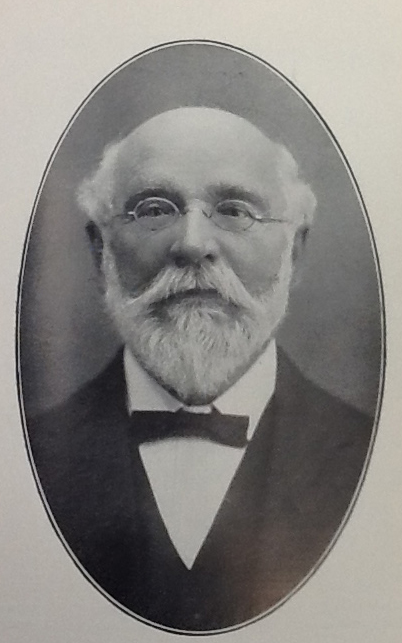
William Henry Simpson (DDBI Annual Report)
Background and Business Life
William Henry Simpson was born at Warrenpoint, County Down, Northern Ireland in 1834 to Ebenezer (1795-1855) and Sarah Simpson (1796-1878)[3] and arrived with his parents in Australia in 1838 aboard the ship Parland.[4] At Newry in Ireland, Ebenezer had been a master tanner and so when he arrived in Australia with his family, settling first at Windsor then at Richmond, he worked for Wright’s tannery in Parramatta.[5] In 1843, he commenced a tannery business at Camden, NSW.[6] While William’s brothers, Ebenezer (Jnr) and Alexander, were to become tanners and join the family business,[7] William was apprenticed as a saddle and harness maker to William S Mitchell of Camden[8] for the period from around 1848 until 1855.[9] Emerging from his indentures in 1855, it is said that William entered into a partnership in a saddle making business with Thomas Davis. Davis died in July 1855[10] and the partnership in the name of Simpson and Davis first saw the light in June 1856.[11]
It appears that William initially worked with Davis but on his death, which took place soon after William joined the saddlery, he entered a business partnership with Thomas’ widow. The saddlery was situated in various Pitt Street North addresses, but from January 1859[12] William had no partner. In 1861, he entered a partnership with James David Jones at 325 George Street[13] with the business name of Jones and Simpson. This partnership continued until 1863[14] when Simpson assumed sole ownership of the business which became W H Simpson, Saddler.[15] In 1887, his son William Walker Simpson joined him as a partner and the business was designated, W H Simpson and Son.[16] Simpson carried on in business until 1910 when he retired and the business was sold.[17] He had conducted a successful and prosperous business as he sold a commodity, equipment for horses which was central to personal and commercial transport, and which was in demand. At his retirement in 1910, however, he remarked:
Yes, I suppose the saddlery business generally it has made great strides, but in some respects it has fallen off. The coming of the motor car has, for instance, meant the making – taking into account the increase of population – of far fewer sets of carriage harness. Where nowadays you see a long row of motor cars lined up opposite the big shops in Pitt street, you used to see as many carriages. Everyone who was at all well off used to have his carriage and pair, and very smart most of them were. On the other hand the growth of the farming industry has made, a wonderful difference in the amount of harness made for farm-work. In fact, it is almost impossible to keep pace with the orders that come in.[18] (more…)
Public opinion and the provision of a Magdalen Asylum in Sydney
At a meeting of the St Patrick’s Society in Sydney in 1841, the Rev Joseph Platt, a Roman Catholic priest, proposed the formation of
a society among Catholic ladies for the establishment of a Magdalen asylum, or an institution which would afford a refuge to such unfortunate females as are in some measure driven to destruction by circumstances, and to those who, having erred, would gladly forsake their evil courses had they a home and a friend to whom they could fly for protection.[1]
Platt clearly thought of his proposed Magdalen Asylum as a Catholic concern.
At a public meeting in April 1842, the Hobart Magdalen Society was formed by the local community for the purpose of developing an Asylum. In July 1843, it reported some encouraging results, but it had not managed to obtain a property to open as an Asylum.[2] In the following month, a Catholic Magdalen Asylum in Hobart was contemplated by the Rev John Joseph Therry. He confidently publicised his expectation, possibly not to be outdone by the already existing Hobart Magdalen Society, that the Sisters of Mercy would soon arrive and a Catholic Magdalen Asylum for the reception of Female Penitents would be opened and placed under their direction.[3] The Sisters did not arrive, however, and the Asylum of which Therry spoke did not eventuate.
In Sydney in January 1843, the Sydney Catholic Australasian Chronicle reported that a ‘proposition is on foot for the establishment of a Magdalene asylum’,[4] and in March a letter appeared in the SMH pointing out the need for an asylum for prostitutes and asking the Mayor to initiate such an institution.[5] Nothing eventuated, but the matter of a Sydney Magdalen Asylum was again raised in a letter to the SMH in January 1846 and, in the following month, in the Catholic Morning Chronicle. These letters discussed the problem of prostitution and made a suggestion of publicly naming and shaming those landlords who allowed their properties to be used as brothels. They also called for the ‘philanthropic and humane’ to assist in the provision of a Magdalen institution.[6] The consciousness of the need, and perhaps a desire to set up a Magdalen Asylum, seems to have been impressed on some in the Catholic community for at his death in January 1846, George Segerson, a Catholic publican, left a legacy of £50 towards the ‘establishing of a Magdalene Asylum in the City of Sydney’.[7] Later, in April 1846, the Sentinel was direct when it said:
… we exhort and implore the virtuous and happy of the female sex, to look with a more favourable eye on the distresses of these unfortunate creatures who are now pining in degradation and misery; and to unite their influence, which is supreme, over their aristocratic lords, for the benevolent purpose of establishing an Asylum for such as choose to abandon the error of their ways, and to embrace a more reputable line of life. Let a committee of ladies, headed by Lady Gipps, Lady O’Connell, Lady Mitchell, Mrs Thompson, Mrs Riddell, Mrs Plunkett, Mrs Therry, Mrs Stephen, and as many more as they choose to select, be formed for the purpose of carrying out this desirable object – and a Magdalene Asylum for the reformation, protection, and salvation of hundreds of unhappy females raise its head, conspicuously in the City of Sydney …[8]
 Philanthropists and Philanthropy