
Home » Posts tagged 'masonic'
Tag Archives: masonic
Andrew Torning (1814-1900) a not very useful addition?
‘He is not calculated to be very useful here’ was a theatre critic’s verdict on Andrew Torning one month after Torning’s arrival in Sydney. Nearly 60 years later, a review of his life would recall him as a more than useful addition, and this usefulness extended to numerous areas in the development and growth of the colony of New South Wales. Andrew Torning was born in London, England, 26 September 1814, the son of Andrew Torning (1784-1815), Master Mariner, and Ann Dayton. It has been suggested that Andrew’s father was Danish, as the name ‘Torning’ is present in Scandinavia, however, there is no evidence to support this suggestion.[1] His father was the Master of the vessel Hamilton and he drowned on 9 September 1815 when his ship was lost in a gale while sailing between Jamaica and London.[2]
Andrew, who was a painter of both houses and theatrical backdrops, married Eliza Crew at St. Leonard’s church, Shoreditch, England, on 9 July 1832. They had two children, Thomas Andrew (1834-1868) and Eliza (1836-1862), and by 1841 were living in Provost Street, Hoxton, New Town.
On 18 May 1842, Andrew and Eliza were onboard the barque Trial as it left Plymouth bound for Sydney via Rio de Janeiro and they arrived in Sydney on 21 October 1842. This concluded a long and slow journey in which the trip to Rio de Janeiro had taken 15 or so weeks when it normally took seven.[3] What was the inducement for Andrew and Eliza, with their two young children then aged eight and six, to leave England and come to Australia? The answer is ‘the theatre’.

Colonial Theatrics
Joseph Wyatt was the owner of the Royal Victoria Theatre in Sydney and he had decided he needed some fresh performers for his theatre. In order to obtain them, he boarded the Royal George and left Sydney on 21 March 1841 bound for London.[4]The Sydney public was informed that
Mr Wyatt, is about proceeding to England, where that gentleman proposes to engage an efficient number for all the several branches of the department. For the professional part of Mr Wyatt’s embassy, we confidently rely on his judgment and liberality; and in his private relations …[5]
During 1841 and 1842, Andrew and Eliza were both performers at the Royal Albert Saloon, Shepherdess Walk, City-road, London. This was a minor theatre and was part of Henry Bradley’s Royal Standard Tavern and Pleasure Gardens. It featured concerts, vaudevilles, melodramas, animal acts, fireworks, ballooning, and weekly dances, and the price of admission was usually not more than sixpence.[6]
The couple had adopted the ‘stage name’ of Mr and Mrs Andrews, she as a dancer[7] and he, in the company of others, doing ‘Herculean Feats’.[8] Learning that they were leaving for Sydney, the Royal Albert Saloon Company gave a benefit in their honour.[9] The Company’s Saloon was a conveniently situated venue for the couple as they lived in Provost Street which was a short walk from the theatre. Andrew was a painter by profession and, as he later showed significant skill in painting theatre backdrops (or act drops),[10] this probably was his main source of income and it is doubtful that their theatrical efforts gave them much financial security. The opportunity to come to Sydney meant an increase in income as the average stipend for those who performed at the Albert Saloon was between 15 and 25 shillings whereas in Sydney they would earn from four to six pounds.[11] Sydney was also possibly an enhanced opportunity to be more engaged in the theatre.
(more…)William Henry Simpson (1834-1922), Saddler, Mason, Local Government – a governance philanthropist
On the death of William Henry Simpson in 1922 it was said that ‘Sydney has lost a good, useful citizen’.[1] Who was this good citizen and how had he been useful? Of his wife Ann, it was said that she ‘was well known in charitable and church work in Waverley, and was highly esteemed by all who knew her’[2]. In what way had these good citizens contributed to the nation of which they were a part?
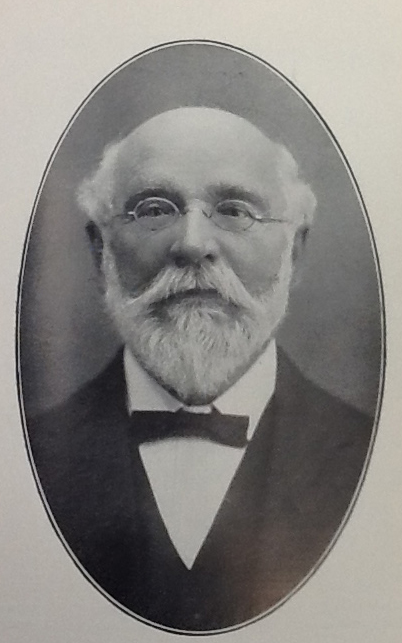
William Henry Simpson (DDBI Annual Report)
Background and Business Life
William Henry Simpson was born at Warrenpoint, County Down, Northern Ireland in 1834 to Ebenezer (1795-1855) and Sarah Simpson (1796-1878)[3] and arrived with his parents in Australia in 1838 aboard the ship Parland.[4] At Newry in Ireland, Ebenezer had been a master tanner and so when he arrived in Australia with his family, settling first at Windsor then at Richmond, he worked for Wright’s tannery in Parramatta.[5] In 1843, he commenced a tannery business at Camden, NSW.[6] While William’s brothers, Ebenezer (Jnr) and Alexander, were to become tanners and join the family business,[7] William was apprenticed as a saddle and harness maker to William S Mitchell of Camden[8] for the period from around 1848 until 1855.[9] Emerging from his indentures in 1855, it is said that William entered into a partnership in a saddle making business with Thomas Davis. Davis died in July 1855[10] and the partnership in the name of Simpson and Davis first saw the light in June 1856.[11]
It appears that William initially worked with Davis but on his death, which took place soon after William joined the saddlery, he entered a business partnership with Thomas’ widow. The saddlery was situated in various Pitt Street North addresses, but from January 1859[12] William had no partner. In 1861, he entered a partnership with James David Jones at 325 George Street[13] with the business name of Jones and Simpson. This partnership continued until 1863[14] when Simpson assumed sole ownership of the business which became W H Simpson, Saddler.[15] In 1887, his son William Walker Simpson joined him as a partner and the business was designated, W H Simpson and Son.[16] Simpson carried on in business until 1910 when he retired and the business was sold.[17] He had conducted a successful and prosperous business as he sold a commodity, equipment for horses which was central to personal and commercial transport, and which was in demand. At his retirement in 1910, however, he remarked:
Yes, I suppose the saddlery business generally it has made great strides, but in some respects it has fallen off. The coming of the motor car has, for instance, meant the making – taking into account the increase of population – of far fewer sets of carriage harness. Where nowadays you see a long row of motor cars lined up opposite the big shops in Pitt street, you used to see as many carriages. Everyone who was at all well off used to have his carriage and pair, and very smart most of them were. On the other hand the growth of the farming industry has made, a wonderful difference in the amount of harness made for farm-work. In fact, it is almost impossible to keep pace with the orders that come in.[18] (more…)
 Philanthropists and Philanthropy