
Home » Posts tagged 'James Cameron'
Tag Archives: James Cameron

Walter Vincent: Funds, Fatigue and Fraud – an aspect of charity in nineteenth-century NSW
Walter Vincent alias Brown was a member of the opportunistic profession of the sweet-talking donation fraudster. He presented himself as a genuine collector of subscriptions for various charities, but he was not.
Obtaining funding for the work of the various nineteenth-century philanthropic organisations was always a challenge. There was little government financial assistance available, and the various charitable organisations were dependent upon the generosity of the public for financial support. To gain that support, the many charities that wished to collect money from the public engaged in a number of activities and strategies. Prominent among their activities was the public annual meeting, often chaired by a socially important person, where the activities of the organisation were reported and supportive resolutions passed. At the meeting, someone, usually the committee secretary, would read a report detailing what had been achieved in the past year, often giving encouraging examples of success and underlining the difficulty of the task which the charity had undertaken. Such reporting made the committee that ran the charity accountable to the public and to its subscribers. It also showed what had been achieved through public financial support, educated the community on the continuing need for the charity, and gave hope for success in the future, so that there might be continued interest and increased financial support given by individuals. These meetings were often widely reported in detail by the press, which devoted considerable space to them.
During the 1890s through to the first decade of the 1900s, the colonies of Australia experienced a severe economic depression. Businesses reported a slowness in trade, a drop in profits, the need to shed workers and in the case of many, through indebtedness and an inability to service loans, to declare bankruptcy. On the personal front, and as a result of reduced income, this meant less food on the table and less access to medical assistance if needed. There was an increase in unemployment as businesses, both large and small, sought to reduce expenditure in an attempt to survive the times.
(more…)Professor John Smith (1821-1885): Theosophical Dabbler or Devotee?
John Smith (1821-1885), foundation professor of chemistry and experimental physics at the University of Sydney, was born on 12 December, 1821, at Peterculter, Aberdeenshire, Scotland, the son of Roderick Smith, blacksmith, and his wife Margaret, née Shier. From 1839 he studied at the Marischal College, Aberdeen (M.A., 1843; M.D., 1844). Smith arrived in Sydney on 8 September, 1852, on the Australian.[1]
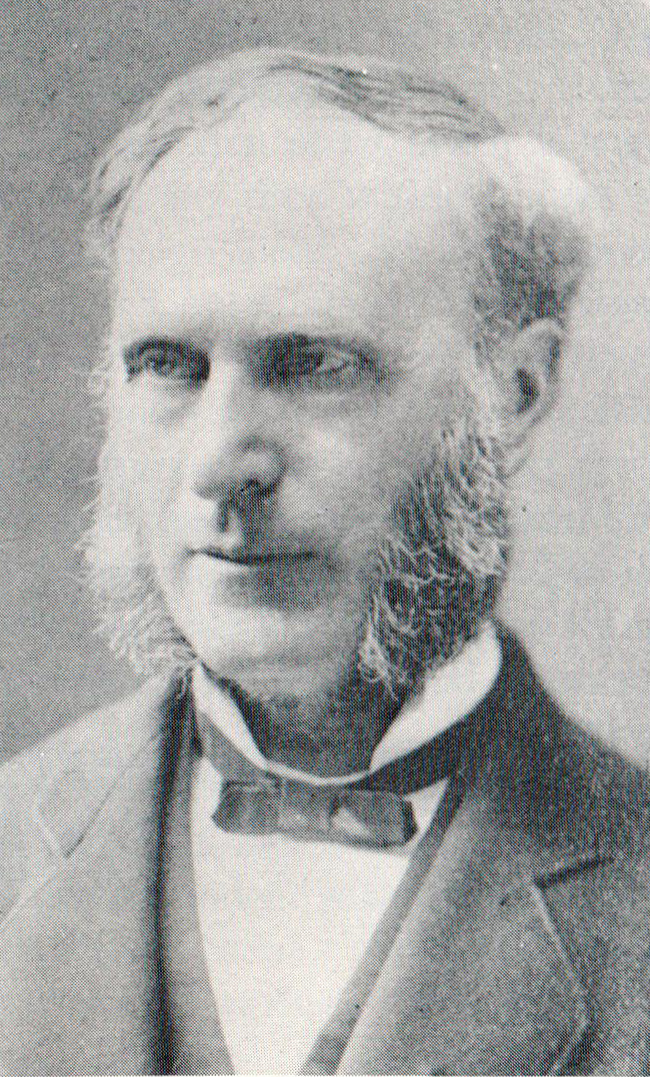
Professor John Smith
There is a good deal of information available on Smith, but little work has been done on his philanthropic and religious views. An article from Sydney University, which understandably concentrates on his scientific work, briefly mentions his philanthropic interests but omits to make any mention at all of his religious commitments which were also an important feature of his life.[2]
The Australian Dictionary of Biography says of his religious views that ‘In the 1860s Smith served on the committees of several religious organizations’, by which is meant Christian organisations, and that
In January 1882 he had called at Bombay and joined the Indian section of the Theosophical Society, having been influenced by his wife’s spiritualism and the lectures of the theosophist Emma Hardinge Britten in Australia in 1878-79. In Europe in 1882-83 he experimented with the occult.[3]
This article’s religious emphasis falls on the last five years of Smith’s 63-year life and has little to say about his religious commitments during the previous 58 years. This is reflective of Jill Roe’s work which is mainly concerned with Smith’s interest in Theosophy[4] and, while not said overtly, she seems to want to paint Smith as a theological progressive moving from the strictures of a doctrinal Presbyterianism to Theosophy. For Roe, Smith’s encounter with Theosophy was about ‘religious progress’ and the ‘maintenance of true religion’.
The usual paradigm for recruits to spiritualism was one of a theological ‘progress’ which moved from a nineteenth-century disillusionment with the revelation-based approach of Christianity to the intuitive approach to religious knowledge of theosophy. The disillusionment with revelation was rooted in an uncertainty about the Bible, fed by the rise of biblical criticism, the theory of evolution and an increased moral sensitivity repulsed by various biblical events. The problem with this hinted assessment of Smith is that while there is clear evidence of his interest in theosophy there is no evidence to support a disillusionment in his Christian thought, a point which Roe concedes.[5] Roe equates Smith’s interest in theosophy with a desire for ‘religious progress’, but it could equally be a case of intellectual curiosity. For a Professor of Physics, the role and reputed powers of the masters in theosophy would raise serious questions about the nature of matter and spirit. Perhaps it is from a desire for ‘scientific progress’ rather than ‘religious progress’ that Smith’s chief motivation to understand spiritualism arose. That is not to say that Smith had no interest in what Theosophy might have to say about spiritual matters. Rather, it might be better to see Smith as, to use Malcolm Prentis’ expression, a ‘dabbler’[6] in Theosophy rather than a devotee. This article seeks to examine such a possibility. (more…)
 Philanthropists and Philanthropy