
Home » Posts tagged 'Arthur Balbirnie'
Tag Archives: Arthur Balbirnie

Walter Vincent: Funds, Fatigue and Fraud – an aspect of charity in nineteenth-century NSW
Walter Vincent alias Brown was a member of the opportunistic profession of the sweet-talking donation fraudster. He presented himself as a genuine collector of subscriptions for various charities, but he was not.
Obtaining funding for the work of the various nineteenth-century philanthropic organisations was always a challenge. There was little government financial assistance available, and the various charitable organisations were dependent upon the generosity of the public for financial support. To gain that support, the many charities that wished to collect money from the public engaged in a number of activities and strategies. Prominent among their activities was the public annual meeting, often chaired by a socially important person, where the activities of the organisation were reported and supportive resolutions passed. At the meeting, someone, usually the committee secretary, would read a report detailing what had been achieved in the past year, often giving encouraging examples of success and underlining the difficulty of the task which the charity had undertaken. Such reporting made the committee that ran the charity accountable to the public and to its subscribers. It also showed what had been achieved through public financial support, educated the community on the continuing need for the charity, and gave hope for success in the future, so that there might be continued interest and increased financial support given by individuals. These meetings were often widely reported in detail by the press, which devoted considerable space to them.
During the 1890s through to the first decade of the 1900s, the colonies of Australia experienced a severe economic depression. Businesses reported a slowness in trade, a drop in profits, the need to shed workers and in the case of many, through indebtedness and an inability to service loans, to declare bankruptcy. On the personal front, and as a result of reduced income, this meant less food on the table and less access to medical assistance if needed. There was an increase in unemployment as businesses, both large and small, sought to reduce expenditure in an attempt to survive the times.
(more…)Charles Nightingale (1795-1860), Edward Ramsay (1818-1894), Arthur Balbirnie (1815-1891) and James Druce (1829-1891), Charity Collectors
Obtaining funding for the work of the various nineteenth century philanthropic organisations was always a challenge. There was little government financial assistance available, and the various organisations were dependent upon the generosity of the public for financial support. In order to gain that support the many charities who wished to collect money from the public engaged in a number of activities and strategies. Prominent among their activities was the public annual meeting, often chaired by a socially important person, where the activities of the organisation were reported and supportive resolutions passed. At the meeting someone, usually the secretary of the committee, would read a report detailing what had been achieved in the year past, often giving encouraging examples of success as well as underlining the difficulty of the task which the charity had undertaken. Such reporting made the committee that ran the charity accountable to the public and to its subscribers. It also showed what had been achieved through public financial support, educated the community on the continuing need for the charity, and gave hope for success in the future so that there might be continued interest and increased financial support given by individuals.
Nineteenth century newspaper editors, at least up until the 1890s, gave very sympathetic treatment to such organisations and often printed extensive reports of the meetings which gave further publicity. Printing the annual reports of these organisations and circulating them to their subscribers was also a vital part of the strategy. Such documents contained the secretary’s report, a financial statement, the lists of subscribers and the amount of their subscription, and newspapers often printed subscriber and donation lists as well. It has been suggested that the existence of these subscriber lists is evidence that nineteenth century philanthropy was a morally approved way of self-aggrandisement.[1] Motives are difficult to determine and it may well be that, for some, giving was motived by being seen to have done the ‘right societal thing’ or by a desire to gain praise for the size of a donation. For others, however, such support was undoubtedly a response to need and a desire to help without any ulterior motive. From the organisations’ point of view, it was an effective means of giving a receipt and perhaps a means of encouraging others to follow the example and also give to the cause.
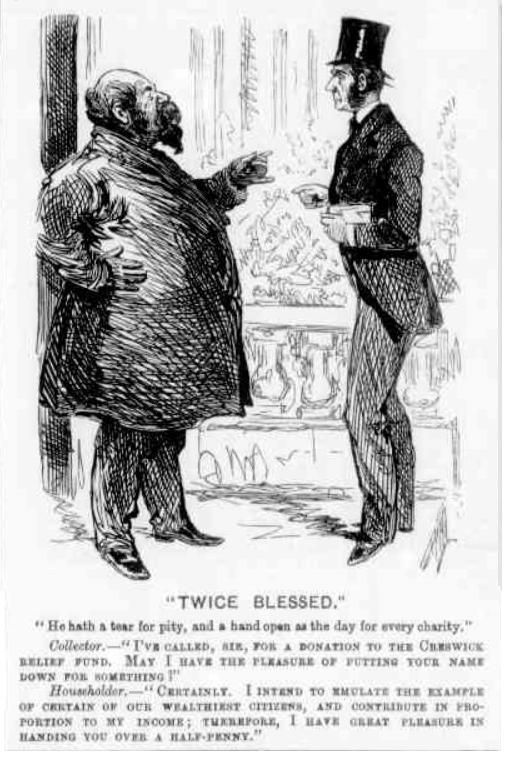
Melbourne Punch December 28, 1882
How were these donations achieved? Some donations were spontaneously received by the charity as a result of its publicity. Often, in the period immediately after the formation of (more…)
 Philanthropists and Philanthropy