
Samuel Callaghan was born in Londonderry, Ireland, on 23 February 1809, or possibly 8 March 1808, as credible sources differ. He was the son of James Callaghan, a shoemaker, and his wife Mary, nee Forsythe.[1] Samuel followed his father’s trade and became a shoemaker, and on 8 March 1829 at Drumachose, Londonderry, Ireland, he married Mary Ann nee May (1811-13 July 1894).[2] Nine years later, on 19 October 1838, Samuel and his wife, plus their four children James (1829-1910), Robert (1832-1874), Jane (1833-1920) and John (1837 -1915), embarked on the ‘Susan’ leaving Londonderry and arriving in the colony of NSW on 5 March 1839[3] as part of a shipload of 261 government sponsored emigrants.[4]
Church
About 1828 and when in Ireland, Callaghan had become a member of the Wesleyan Church, and upon arrival in New South Wales, he connected with the Wesleyan Church in Macquarie Street, Sydney, and later became a teacher in the Druitt Street Wesleyan Sunday School. After a few years, he moved to the Chippendale circuit and, with others, established a Sunday School there. Later, he connected with the York Street Church and subsequently with the Burke Street circuits. For about eight years, from around 1872, he was superintendent of the Hay Street Wesleyan Sunday School and retired from this work in about 1880 due to poor health.
The Sydney Wesleyan Sunday School Union, of which Samuel was a member from at least 1846, reported in that same year that their student numbers had increased by 311 to a total of 978, with an increase in teachers of 36; this brought the total number of teachers to 106.[5] Sunday School teaching, to which Callaghan devoted approximately 40 years of his life, would prove to be a significant source of growth for the Wesleyan Church. Around 1851, he became a committee member of the Wesleyan Mission Society NSW Auxiliary, an organization dedicated to supporting the outreach of the Wesleyan Church through Missions.[6]
At his death on 29 August 1884, Callaghan had been associated with various efforts of the Wesleyan Church in the colony of NSW for a period of 45 years, and for about 11 years in Ireland prior to coming to Australia.[7] His family maintained an active involvement in Wesleyan/Methodism well into the 20th Century, and one of his grandsons, Robert Samuel Callaghan, was hailed by The Methodist as ‘a prince and a great man’ of Australian Methodism.[8]
Business
Samuel Callaghan began his boot-making business at 291 George Street, Sydney, around 1844[9] and the business operated for nearly 90 years through the work of three generations of the family. By 1857, Samuel operated a boot and shoe shop at 97 King Street as well as a boot and shoe Warehouse at 358 George Street.
In 1861, a fire destroyed the King Street business; Samuel was injured in the fire but recovered.[10] He advised his customers that because of ‘the disastrous fire, his Branch Establishment in [97] King street is CLOSED for a few days’ and customers were directed to his ‘old established Boot and Shoe Warehouse, 358, Brickfield Hill.’[11]
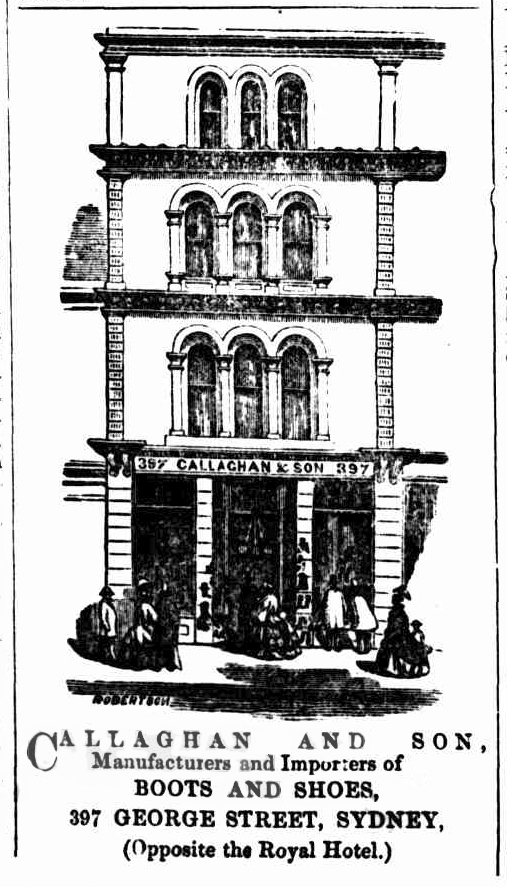
| Illustrated News, 16 September 1864, 16 |
Perhaps an inspection of the fire-damaged shop and stock gave Callaghan a better idea of the damage done and the cost of refurbishment. So, despite being insured, Callaghan chose to permanently close the branch establishment at 97 King Street.
In January 1862, he expanded, revamped and moved his business from 358 George Street to 397 George Street and opened as Callaghan and Son, ‘having taken one of those commodious and extensive premises’,[12] a graphic of which some of their advertising highlighted. This shoe and boot warehouse or shop was to become a notable establishment in colonial Sydney.[13] Initially, Samuel had worked alone as a shoe and boot importer and manufacturer, but eventually all three sons became involved in all aspects of the shoe/boot making, importing and selling business.
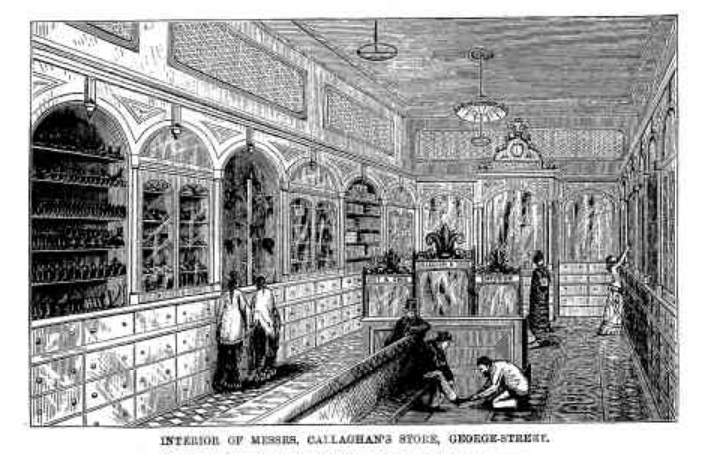
Callaghan’s store in the 1870s
Illustrated Sydney News and New South Wales Agriculturalist and Grazier (NSW) 13 Jul 1878 9
By 1855, James and Robert were boot and shoe makers in Melbourne, employed in the firm J and R Callaghan. Callaghan and Son in Sydney were constantly exporting to Melbourne, presumably to the Melbourne-based Callaghan business.[14] In 1873, Samuel retired from the business and his son John, along with a son-in-law, WA Cooke,[15] continued in partnership trading as Callaghan and Son.[16] In 1886, on the death of Cooke, the partnership was dissolved and a new family one business was formed between John Callaghan and two of his sons.[17]
It is unknown what sort of employer Callaghan showed himself to be. He was, however, in 1861, a supporter of the Early Closing Movement and along with 36 other boot and shoe warehousemen in Sydney, he pledged to close his establishment at 7 o’clock pm (Saturdays and the eve of general holidays excepted), from and after Monday, 18 March 1861.[18]
Sydney Permanent Freehold Land and Building Society
In 1875, an advertisement signalled the intention to hold an election for Directors of the Sydney Permanent Freehold Land and Building Society (SPFLBS), and both Samuel and his son-in-law, WA Cooke, stood for election; Callaghan was elected.[19] The SPFLBS was both commercial and philanthropic in intent. In 1878, a provisional prospectus was issued for the SPFLBS, indicating that the purpose of the Society was chiefly to build improved dwelling houses for the industrial classes, upon a plan combining neatness and convenience, with the greatest economy. Shares were unlimited in number. ‘Investors’ (paid up) shares, £20 each; half shares, £10 each. Contributors’ fortnightly payments, 1s per £20 share, until house or land is allotted to them; afterwards 2s 2d per share. Entrance fee, 1s per share.’ The society had its offices in the Temperance Hall,[20] and Samuel remained a director until 1882.[21]

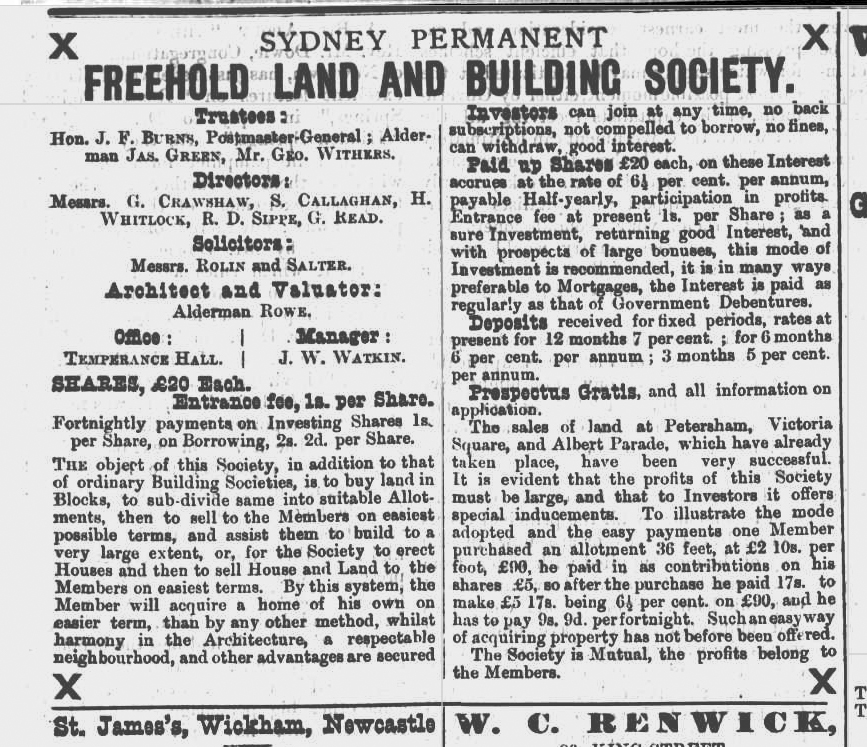
| Evening News (Sydney, NSW), 22 July 1875, 3. The Protestant Standard (Sydney NSW), 9 Dec 1876, 10 |
Philanthropic Activities
Callaghan aided in the foundation of the Wesleyan or Protestant Union Benefit Society (WPUBS)[22], which was formed on 7 June 1848[23], and he was the founding President.[24] At least from 1863 to 1869, he was its treasurer and probably for a considerable time thereafter.[25]
The object of the Society was to provide medical attendance for the sick, the provision of drugs at reduced cost and a funeral allowance.[26] The positions of a doctor and a druggist to work for the WPUBS were advertised and awarded by tender. There was no religious test for membership in the WPUBS other than members having to be ‘attendants’ at a Protestant place of worship. The membership of the Society was not large (100 in 1864, 140 in 1875 and 139 in 1883) but by 1863, Callaghan, as chairman and at a special meeting of the Society, indicated that financially the society was ‘In so flourishing a condition that they needed no collections’,[27] and by 1875, he said that the Society was ‘never in a more satisfactory condition’.[28]
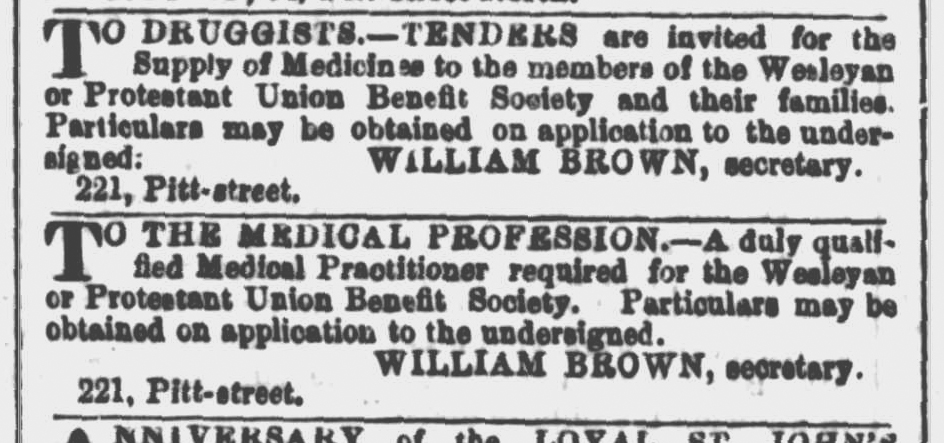
| SMH, 5 October 1864, 1 |
The Temperance Movement, in its various forms and activities, had Callaghan’s support.
1842 He was a speaker at an Australian Total Abstinence Society meeting.[29]
1854 He was a founding member of the NSW Total Abstinence Society, and he supported its efforts to petition the government for improved liquor laws.[30]
1858 As chairman of the Christian Total Abstinence Society, he made representations and contributions to the NSW Parliament in regard to the Publicans Licensing Bill.[31]
1865- 1880 Although not a committee member at its formation, Callaghan was clearly supportive of the aims of the New South Wales Alliance for the Suppression of Intemperance and for the Social, Moral and Intellectual Uplift of the People, which was founded in 1857,[32] and he was an active committee member from 1865.[33] This organization had weekly Thursday night meetings at the Temperance Hill in Pitt Street, Sydney, where lectures were given on topics related to temperance and the issues associated with the consumption of alcohol.[34]
1866-1872 Callaghan was a foundation committee member of the NSW Political Association for the Suppression of Drunkenness (NSWPASD)[35], and he was a member of the Delegation to the Colonial Secretary re The Permissive Bill. The object of the bill was to obtain an alteration in the present licensing law, and especially the enactment of a permissive law…. The bill, if passed into law, would give to the inhabitants of any district, who choose to adopt it, the power to abolish altogether the retail sale of intoxicating drinks…[36]
1869 He was a member of No. 8 (Surry Hills) division of Sons of Temperance ( where he also chaired a meeting).[37]
The Penny Bank
Samuel was a supporter of the Penny Bank method of securing some degree of financial security for depositors against possible adverse circumstances. The Surry Hills Wesleyan Penny Bank was conducted in the Bourke Street Schoolroom with a branch in the Paddington Wesleyan Church; both places were open for business from 7 pm until 8 pm each Saturday evening. The bank was begun in January 1862[38], and Samuel became involved in 1863 [39] and was probably involved as a Trustee of the Bank for the rest of his life.[40] At Samuel’s death, the Surry Hills Wesleyan Penny Bank, during its 24th annual meeting, acknowledged his ‘long and valuable service.’[41]
Other philanthropic activities
Committee member of the City Mission (1864-1884)[42]
Supporter and earnest advocate for the Sydney Female Refuge Society (1864-1884)
Director of the Benevolent Asylum (1864-1882)[43]
Member of the committee of the Sydney Night Refuge and Reformatory from 1869 to 1882[44]
Samuel Callaghan came to the colony of NSW and built a successful business manufacturing and selling shoes and boots. As a Wesleyan Christian, he diligently supported his church in all its activities but especially in teaching Sunday School. His support of the temperance movement and his long-term involvement in and continuous support of organisations such as the Sydney Female Refuge Society, the Benevolent Society, the Sydney City Mission and the Sydney Night Refuge and Reformatory were impressive. His success in business permitted him the time to be involved in philanthropic work, and his Wesleyan faith gave him the encouragement to do so.
Paul F Cooper
Research Fellow
Christ College, Sydney
The appropriate way to cite this article is as follows:
Paul F Cooper, Samuel Callaghan (1809- 1884), shoes, temperance and benevolence Philanthropy and Philanthropists in Australian Colonial History 04/10/2025 available at Colonialgivers.com/2025/10/04/samuel-callaghan-1809-1884-shoes-temperance-and-benevolence
[1] It would seem that Samuel was born in Killea, Donegal, which is very close to Londonderry. His grave says Londonderry, and the documents for assisted immigration had Parish of Kellay, Donegal, which is where Killea is located. https://mail.google.com/mail/u/2/?ogbl&zx=skzr7at7nqjo#inbox
The differing birth dates are due to a difference between the date given in his obituary and that given on his Emigrant documentation.
[2] Daily Telegraph (Sydney, NSW), 15 September 1884, 4.
[3] The Australian (Sydney, NSW), Feb 1839, 2; New South Wales, Australia, Assisted Immigrant Passenger Lists, 1828-1896 for Samuel Callaghan.
[4] The Sydney Gazette and New South Wales Advertiser (NSW), 2 Feb 1839, 2.
[5] SMH, 3 Jun 1846, 3.
[6] SMH, 14 May 1851, 3; 9 Jun 1852, 3; 29 Jun 1853, 5; 5 Jul 1854, 3; 6 Jun 1855, 3; 11 Feb 1862, 4; Empire (Sydney), 24 Oct 1865, 5.
[7] James Colwell, Illustrated History of Methodism (Sydney: William Brooks and Co, 1904), 474.
[8] The Methodist (Sydney, NSW), 23 Feb 1946, 12.
[9] SMH, 14 Feb 1929, 15; Callaghan, Samuel, Boot and Shoemaker, 291 George Street, Directory Sydney, 1847, Low, p24; SMH, 24 Dec 1849, 2.
[10] The Maitland Mercury and Hunter River General Advertiser (Maitland, NSW), 2 May 1861, 3.
[11] SMH, 22 Apr 1861, 5.
[12] SMH, 9 Jan 1862, 8.
[13] Evening News (Sydney, NSW),13 Dec 1900, 8.
[14] The Argus (Melbourne, Vic.), 19 Jun 1855, 7.
[15] William Adolphus Cooke was 49 when he died. SMH, 31 Mar 1886, 1. He had married Jane Samuel’s eldest daughter, Jane, on 17 October 1865. Sydney Mail (NSW), 28 Oct 1865, 9.
[16] New South Wales Government Gazette (Sydney, NSW), 18 Jul 1873 [Issue No.178], 1998.
[17] New South Wales Government Gazette (Sydney, NSW), 4 Aug 1886 [Issue No.421], 5225.
[18] Empire (Sydney, NSW), 18 Mar 1861, 1.
[19] Evening News (Sydney, NSW), 22 July 1875, 3; The Protestant Standard (Sydney, NSW), 9 Dec 1876, 10.
[20] SMH, 14 Nov 1874, 2; 18 Sept 1875, 4.
[21] Evening News, 1 March 1882, 8.
[22]The Sydney Mail and New South Wales Advertiser (NSW), 6 Sept 1884, 462.
[23] SMH, 22 June 1849, 2. The Australian Almanac-1864, (Sydney; Sherriff and Downing, 1864) gives 1846 as the date.
[24] Australian Almanac-1864, (Sydney; Sherriff and Downing, 1864)
[25] Empire (Sydney, NSW), 10 Nov 1863, 5; Protestant Standard (Sydney, NSW), 30 October 1869, 3.
[26] Evening News (Sydney, NSW), 20 Jan 1875, 2; The Australian Almanac-1864 (Sydney; Sherriff and Downing, 1864).
[27] Empire (Sydney, NSW), 10 Nov 1863, 5.
[28] Evening News (Sydney, NSW), 20 Jan 1875, 2; SMH, 21 Jan 1875, 4; Evening News (Sydney, NSW ), 24 Oct 1883, 5.
[29] The Teetotaller and General Newspaper (Sydney, NSW), 5 Mar 1842, 1.
[30] Empire (Sydney, NSW), 21 Jul 1854, 8; SMH, 25 July 1854, 2; Empire (Sydney, NSW), 25 May 1854, 3.
[31] Empire (Sydney, NSW), 19 June 1858, 4.
[32] SMH, 20 Mar 1857, 5.
[33] SMH, 5 Oct 1859, 1; 22 May 1865, 5 ; The Protestant Standard (Sydney, NSW), 12 June 1869, 3; Evening News (Sydney, NSW ), 24 Mar 1870, 2; Empire (Sydney, NSW), 21 Jan 1871, 3; SMH, 3 Feb 1872, 7; 28 Jan 1874, 3; Empire (Sydney, NSW), 2 Feb 1875, 4; SMH, 29 Jan 1876, 5; 27 Feb 1877, 3; 23 Feb 1878, 5; 1 Mar 1880, 6.
[34] Empire (Sydney, NSW), 11 May 1857, 1.
[35] Sydney Mail (NSW), 15 December 1866, 6; SMH, 13 Jan 1869, 7; Evening News (Sydney, NSW), 24 Mar 1870, 2.
[36] Sydney Mail (NSW), 30 July 1870, 3.
[37] Sydney Mail (NSW), 31 July 1869, 4.
[38] Sydney Mail (NSW) 31 Jan 1863, 10; 20 Sept 1862, 8.
[39] Empire (Sydney, NSW), 5 Mar 1864, 2; SMH, 26 Feb 1885, 7 says 1885 was the 24th Annual meeting, which means the commencement of the bank is to be dated around 1861.
[40] Sydney Mail (NSW), 5 Jan 1867, 4; SMH, 16 Mar 1869, 4; 8 Feb 1870, 4; Empire (Sydney, NSW), 22 Feb 1871, 1.
[41] SMH, 26 Feb 1885, 7.
[42] SMH, 18 May 1881, 6.
[43] SMH, 1 Feb 1871, 5; 26 Jan 1877, 6; 22 Jan 1878, 6; Evening News (Sydney, NSW), 28 Jan 1881, 3; SMH, 10 May 1882, 6. Callaghan did not seek re-election in 1884, SMH, 25 Jan 1884, 3. Samuel’s length of membership of the Benevolent Society is problematic as there is little information available about the Rules governing appointment and reappointment to the Board of Directors; Evening News (Sydney, NSW), 1 Feb 1871, 2; The Protestant Standard (Sydney, NSW), 8 Feb 1879, 7. The Protestant Standard of 1879 says he was a director for 15 years.
[44] Evening News (Sydney, NSW), 4 July 1871, 2; Australian Town and Country Journal (Sydney, NSW), 5 Aug 1882,13.; Australian Town and Country Journal (Sydney, NSW), 4 July 1874.12; Daily Telegraph (Sydney, NSW), 15 September 1884, 4.
 Philanthropists and Philanthropy