
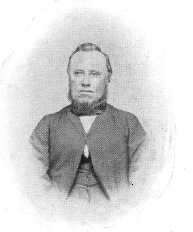
George William Barker was born in London on 5 July 1826, the son of George Barker (1803-1878) a musical instrument maker and Sarah Ann Craddock (1804-1887).[1] He came to Sydney on the Spartan with his parents, three sisters, Mary Ann, Sarah and Emma, and his younger brother, William. They arrived on 31 January 1838 after a voyage of some five months.[2] George’s uncles, Thomas (1799-1875) and James (1797–1861) Barker had arrived in the colony in 1822, some 15 years before, with Thomas[3] working as a clerk for John Dickson (1744-1843) a flour miller.[4] George was educated at Dr Fullerton’s School, Windsor, the King’s School, Parramatta, and the Grammar School Sydney.
Initial Business Involvement
After school and for some time, George partnered with his father as a grocer and corn dealer, in George Street Parramatta. In December 1847,[5] the public was advised that George was leaving the partnership.[6] So it was that in 1848, attracted by the business opportunities afforded by the development of Port Phillip and perhaps with a sense of adventure, he travelled overland with several friends for some 8 weeks to the Geelong area where he settled and ‘found a position in a store’.[7]
Family and Faith
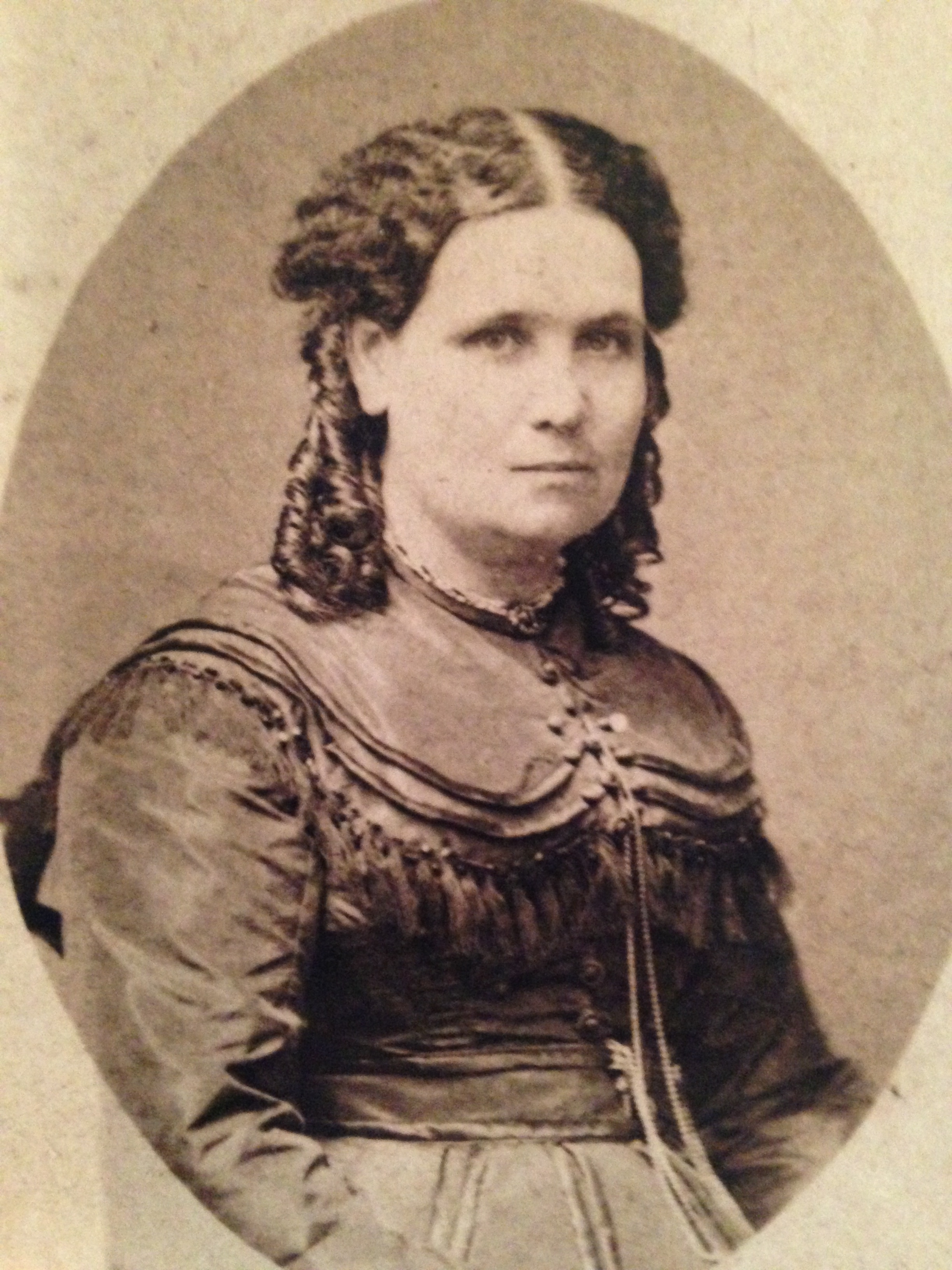
It would appear that the move to the Geelong area was quickly crowned with success for George was soon able to marry. A friend recalled that “soon after a certain young lady went down to Melbourne from Parramatta, and Master George obtaining a week’s holiday started also for Melbourne, and at the end of the week returned with Mrs. Barker.”[8] In 1849 in Melbourne, George had married Eliza Hunt the daughter of Richard Hunt, a saddler and Lydia nee Barber.[9] Eliza was born in the Parramatta area and was known to George before travelling to Geelong.[10] They were to have six children: Sarah Elizabeth (1850-1851), Thomas Richard (1854-1860), Edwin George (1856-1918), Emily Eliza (1858-1931), Alice Maude (1863-1945) and Florence (1865-1867).
The Hunt family were involved with the Parramatta Wesleyan church and while the Barkers were involved with the Presbyterian Church in Parramatta,[11] George is only ever found associated with the Wesleyan Church. According to the Rev Joseph Oram, Barker became a member of the Wesleyan Church at Parramatta before he went to Geelong having been converted ‘during a religious festival when the Rev’s John Watsford and William Moore were brought to Christ’.[12] Watsford was converted at a prayer meeting run by Daniel Draper when he was 18 years old[13] so this would place Barker’s conversion in 1838 when he was around 12 years old.
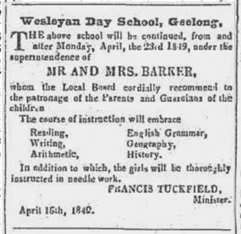
Both George and Eliza Barker were very committed to the Wesleyan Church and in April of 1849, the newly married couple took over the running the Wesleyan Day School, Geelong, from JB Lee.[14] The school had an enrolment of 148, 64 males and 84 females.[15] In May 1849, George was appointed secretary of the Wesleyan Mission Society, Geelong,[16] and in July 1849, he was sufficiently well off to be able to donate £ 1-1-0 to the Wesleyan cause in Geelong.[17] In 1850, he was elected to the Wesleyan Sabbath School Society as the School Secretary[18] and in 1852 he gave £5, a significant donation, to help liquidate the debt on the Wesleyan chapel. By August 1852, however, the Barker’s had ceased to teach at the Wesleyan Day School.[19] In 1854, George became General Secretary of the Wesleyan Sunday schools at New Town, Geelong[20] and in 1856, he was the Hon Sec of the Geelong Sacred Harmony Society.[21]
Geelong Business
Having ceased being a schoolmaster, George opened a store in Great Ryrie Street, Geelong, in September 1852, where his partners were Thomas Barber Hunt and Ebenezer Hooker, operating as Barker & Co. Initially, they offered services as “Drapers” but soon this was expanded to be “Drapers, Grocers, Flour, Hay and Corn Dealers”.[22] By 3 November 1853, Hooker had departed the partnership and it became known as Barker & Hunt. The business changed direction from being merchants to being bakers at Ryrie Street, Geelong, Little Scotland and Ballarat and they sought to employ bakers who were preferably ‘Wesleyan or Teetotalers’.[23]
Their bakery is mentioned by Peter Lawler in connection with the troubles at the Eureka stockade and in one skirmish with troops, the Southern Cross flag was hoisted on the bakery flagstaff.[24] There is no suggestion that Barker or Hunt was involved, but the bakery was in the midst of the action. After six months of operation, the partnership was dissolved and shortly afterwards the bakery caught fire and was burnt to the ground.[25] By November 1855, George had once again entered business on his own behalf opening the Eureka Store, Great Ryrie Street, Geelong,[26] but it would seem that he was making plans to leave Geelong. By February 1859, the business was closed and George and his family moved back to Sydney.[27]
In June 1860, and having returned to Sydney, he took over the bankrupted Walker & Son, a hay, corn and produce merchant.[28] By September 1860, his uncles Thomas and James, trading as flour factors and known as Thomas Barker and Company, dissolved their partnership and the business was carried on by their nephews George William, William Craddock, and Francis Lindsay Barker. The store was on the corner of York and Market Streets, Sydney.
Further changes took place in the business in April 1863 when Francis Lindsay Barker left the partnership and the firm became Barker and Co, Flour Factors and Produce Merchants.[29] Thereafter, the history of the business of Barker & Co is complex and exceeds the scope of this paper but it has been documented and is available.[30] Barker retired from the business in 1880 and his son Edwin took over his role.[31]
The commercial history of partnerships involving GW Barker indicates the dynamic nature of the economic and commercial scene and the difficulty that existed in maintaining stable business relationships in the early colonial period.
Wesleyan Church
On his return to Sydney, George and Eliza made their home in Newtown and George began to immerse himself in the work of the Wesleyan Church. His attitude to such service was clear when he said ‘he had been twenty-two years connected with Methodism, and he hoped that the balance of his days on earth would be spent in the service of that cause’.[32] The Barkers joined the Newtown (NSW) Wesleyan Church around 1860 with George serving in various capacities from 1861-1871 when the family moved to Mylora Esplanade East, Manly, around 1873 and remained there until 1890 when George and Eliza moved to Trafalgar Street, Petersham.
It was said that George ‘had an extensive knowledge of connexional affairs and exercised a powerful influence in many Committees’ and that during his life there were not many offices open to laymen in the Wesleyan Church that he had not filled for ‘he was no idler in his Lord’s vineyard’.[33] He had been a Circuit Steward of Newtown,[34] a trustee and treasurer of Newington College, and a signatory to the trust deed under which all Methodist Church Property in New South Wales was registered.[35] He was also involved with the Newtown Wesleyan Sunday school in 1861, 1862, and 1870;[36] Auditor of the Newtown Penny Bank;[37] Secretary of the Newtown Branch of the Wesleyan Methodist Mission Society;[38] church Treasurer;[39] Wesleyan Church Sustentation and Extension Society – Newtown Branch;[40] and delegate to the Australasian Wesleyan Methodist Conference (1869-1893).[41] He donated £50 to help remove the debt on the Newtown Wesleyan Church[42] and in 1870, as Treasurer of the Wesley College Collection he donated another gift of £50.[43]
When the Barkers moved to Manly in 1873, they attended the Congregational Church as there was no Methodist Church there and he was soon appointed treasurer and became prominent in its activities.[44] In January 1879, he was mentioned as a soloist at a concert to raise funds for repairs to the church. In November 1882, he gave a lecture at the Congregational Church about ‘his recent visit to America’ and ‘in his usual happy style he treated them to a racy and powerful description of places and persons he had seen.’[45]
It was not until September of 1886 that the Executive Committee of the Methodist Conference reported approval of plans for a temporary Church at Manly, and at the Conference in January 1887, it was reported that such Church was nearing completion.
During the proceedings of this Conference, much eloquence was displayed and Mr G. W. Barker strongly protested against any further delay in making an appointment, saying that ‘as a resident of Manly he strongly advocated immediate action,’ and so, twelve years after the site had been purchased and nine years after Conference had heartily and enthusiastically endorsed the then President’s remarks that Methodism should be established at Manly, the Station Sheet read, MANLY —Rev. G. Holford Cowles, who shall visit Gosford one Sunday in every month. The new Circuit thus constituted had three preaching places: Manly, Pittwater or Church Point, and Gosford.[46]
Barker and his family were to be one of the two families that were to be the backbone of the church.[47] After little more than twelve months at Manly, the Rev George Holford Cowles was sent to the Gunning circuit and took with him as his wife Alice Maud Barker, the youngest daughter of the Barker’s. [48]
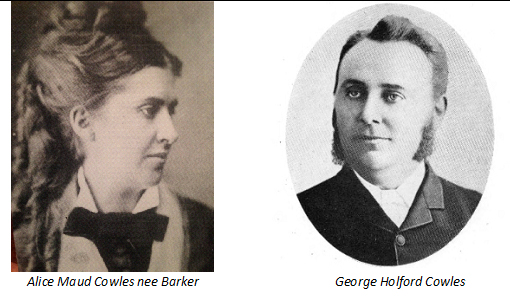
Cowles was a probationer who arrived from England in April 1883[49] and who was to serve as a member of the NSW Wesleyan Conference in other places.[50] Around 1898, he resigned from the NSW Conference to begin a new ministry overseas[51] and he took his wife Alice with him and did not return to visit Australia until 1925. He led an interesting life of constant ‘peregrination’.
Music
As the son of a musical instrument maker, it is not surprising that throughout his life Barker showed an interest in singing and music; he played the flute and sang both in church and at other public occasions.
George was clearly musically gifted and in the Sunday Schools he was associated with he trained the children to sing and present choral items at special events.
In later years, a friend remarked that George ‘had a fine voice, and could also play the flute.’ It appears that while in Parramatta this friend had many opportunities to hear George play and sing for
Mr. Barker started in business on his own account in the grocery line . . . As the shop was situated opposite my house, we used to see each other frequently. I used to hear George’s flute at work very often in the day, which gave me the idea that the business was not a very flourishing one . . .[52]
On the journey overland to Geelong, an event occurred that testified to George’s fortitude and his love of singing as a friend recalled:
We used to divide the night into two watches, two to look after the horses to keep them from straying, while the other two took their sleep. On New Year’s Eve we had a long hot journey. After tea Matthew and I turned in for first watch. We had not been long asleep when we were awoke by George Barker’s powerful voice making the hills around echo with ‘All hail the power, etc.’ He said he intended singing the old year out and the new year in, in fact having a regular BUSH WATCH NIGHT. We could not stop him, so there was nothing for it but to turn out and give up sleep for that night.[53]
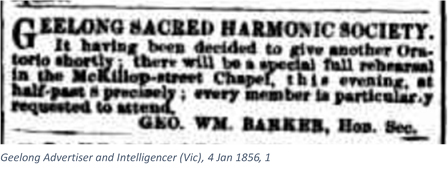
In Geelong, he was secretary of the Geelong Sacred Harmonic Society[54] and at Newtown Wesleyan Church, he taught children how to sing various hymns and anthems, led the church choir[55] and was involved in pubic concerts in connection with Mr Chizlett’s Newtown Singing Class.[56]
In connection with a musical soiree at Newtown for Mr Chizlett’s class, he delivered
a short address in which he spoke of ladies, flowers, poetry, and music, of the chief elements of harmony. He did not know how men could get on without music. Lamech who was the inventor of instrumental music, was the first to have two wives. The necessity produced by the latter circumstances in his opinion led to the former as the only remedy to alleviate his position. Instrumental and vocal music combined was usually had recourse to in olden times on festive or important occasions, even the service of the Tabernacle would have been incomplete without both. Music was always contributory to the pleasantness of marriage festivals. The influence on the human heart was very great. A Persian monarch who had ordered thirty persons to be put to death was induced, through the influence of the music of one of the condemned to countermand the horrible decree.[57]
When at Manly, Barker commenced a choir for the newly formed Manly Wesleyan Church with his daughter Alice Maud as the organist.[58] Her sister Eliza replaced her in this role when Alice married the minister of the parish who, after a mere twelve months, was moved by the Conference.[59] On important occasions, such as the laying of the foundation stone of the Protestant Hall[60] or of the Wesleyan College, Barker was often prepared to contribute to the entertainment by singing or by conducting various combined choirs which sang on such occasions.[61]
Civic Service
Barker was an Alderman on the Camperdown Council in 1870-71.[62] He purchased property at Manly and moved there and became a member of the Manly Public School Board from February 1871.[63] He was strongly in favour of a new school and teacher’s residence being built to serve the Manly community.[64] In 1876, he took part in a vocal concert to raise money for the proposed School of Arts.[65] He was a signatory to the petition for forming the Manly Municipality on 26 July 1876, where he was described as a freeholder;[66] he was clearly in favour of developing Manly as a good place to live.
George was nominated for the position of Alderman for Manly Council to fill the vacancy caused by the death of Alderman James Peters on 20 March 1879 and he stood against the hotelier, Thomas Adrian. Barker was described as a merchant, of East Esplanade, and was nominated by William Smith, Charles Hayes, GM Pitt, WH Rolfe and others. Polling was conducted on 16 April 1879 and Barker was elected, collecting 160 votes to Adrian’s 105.[67] He served until February 1886 when Manly Council Minutes recorded the resignation of Alderman Barker from the Council because he intended to return to England. Mayor Austin thanked him for his contribution to Council over the preceding eight years and hoped he would return to Manly. During his time on Council Barker had been Mayor in 1881-2.[68]
Theology
Little is known of George’s theological views as there are almost no extant examples of his lay preaching and not many of his addresses. The few exceptions to this observation are commented on in the following: At the Manly Church of England when the foundation stone to the church extensions was being laid he said:
Nature with all her voices delivered no testimony of mercy from God for fallen man. For this high purpose God had raised up His Church, and this day in His name they were assembled to lay the foundation stone of the enlargement of a building where the message of this salvation was and would be delivered.[69]
As chairman of the 1881 Ragged Schools annual meeting, an organization upon whose governing board he would serve from 1870 until his death in 1897, he gave a speech in which he expressed some of his core beliefs. Those mentioned were the role in salvation of God’s works; his word; providence and the church; salvation through the atonement of Jesus; life after death:
How desirable was it, therefore, that they should be trained up to be useful citizens-trained up in the paths of virtue, honesty, truth, and religion; to know God through his works, his word, and his providence; and to know the blessings of that great salvation which has been provided for them through the blessed atonement of our Lord Jesus Christ; that they should be taught to know the value of their conscious souls, and their responsibilities in the sight of God. It was necessary that they should be trained not only to perform the duties of the present life, but also to be prepared for the higher and better life that awaits them in the future state. (SMH, 9 August 1881, 3)
Barker’s understanding and support of Missions was shown in a motion he moved at the Wesleyan Conference of 1889:
That in order to the proper maintenance of our existing missions, and the extension of our work in the adjacent groups, this meeting pledges itself to increased efforts for the augmentation of our missionary Income. It strongly urges the necessity of maintaining our missionary prayer meetings in every church; of more systematic and intelligent giving on the part of our people, and for more complete organisation in all our circuits on behalf of our income. The command of Christ, ‘Go ye into all the world’,’ had never been repealed, and would not be until all the generations of men had heard the glad tidings of redeeming love. It was at once a duty and a privilege to be engaged in carrying into effect the purposes and prophecies of Christ.[70]
All of these comments that were made on such public occasions mark him out as a Wesleyan and also, not surprisingly, as an evangelical.
Last Years and Death
Barker visited the Middle East in 1872[71] and with his retirement in 1880, and being ‘a man of great physical energy and activity’,[72] he began to travel overseas. He resigned as Mayor of Manly in May 1882 and travelled to America and on his return gave a lecture in October on ‘my recent trip to America’.[73] He was in London in 1886[74] and was a passenger on an excursion to China and Japan in 1889.[75]
It was on this last trip to Southeast Asia that ‘he broke a blood vessel on the brain in the China Seas through excessive heat’. The result of this was a complex of health difficulties that so enfeebled him that eventually, he was almost entirely dependent on the attention and help of others.[76] By 1895, George’s health had so declined and he was housebound at Llanillo, Stanmore, for the last three years of his life. During this time his minister, Rev Joseph Oram, would visit each Sunday afternoon to conduct a service at his house.[77] In March 1897, the 48th annual meeting of the Sydney Female Refuge committee, of which George had been a member since 1860, sent him their good wishes in respect of his ongoing illness.[78] Aged 71, George died soon after on 22 June 1897 at Llanillo, the home of his son Edwin in Stanmore.[79] Barker was buried at Rookwood Cemetery, Old Wesleyan section along with his wife Eliza, who had died 5 September 1890, aged 65.
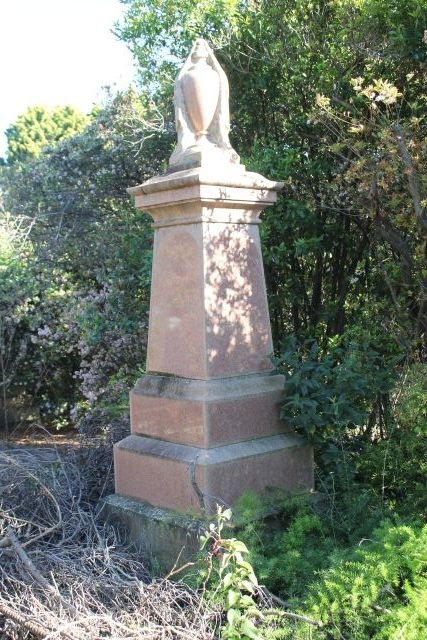
The gravestone was a substantial one utilizing a red granite which, after over 100 years, still clearly denotes the life of George William Barker. His life was one of involvement in the flour business and an impressive array of activity and service in the life of the Wesleyan Church for he was not idle in the Lord’s vineyard.
Paul F Cooper
Research Fellow
Christ College, Sydney
The appropriate way to cite this article is as follows:
Paul F Cooper George William Barker (1826-1897) – Wesleyan, Baker and ‘no idler in his Lord’s vineyard’ Philanthropy and Philanthropists in Australian Colonial History 27/09/2024 available at Colonialgivers.com/2024/09/27/george-william-barker-1826-1897-wesleyan-baker-and-no-idler-in-his-lords-vineyard
[1] George William Barker, Born 5 July 1826; Baptism 30 July 1826, Baptism Register, St Andrew, Holborn , London, Middlesex 1826, 341. This lists his father as a musical instrument maker.
[2] Methodist (Sydney, NSW), 3 July 1897, 8. This account said they arrived ‘after a prolonged voyage of nine months’. This time frame seems to be based on a misunderstanding. It was reported on its arrival in Sydney that the Spartan had completed the journey from Sydney to London and returned to Sydney in a record of ten months which was 1 week shorter than her previous best time. The Sydney Herald (NSW), 1 Feb 1838, 2.
[3] G. P. Walsh, ‘Barker, Thomas (1799–1875)’, Australian Dictionary of Biography, National Centre of Biography, Australian National University, https://adb.anu.edu.au/biography/barker-thomas-1741/text1925, published first in hardcopy 1966, accessed online 9 May 2024.
[4] The Sydney Gazette and New South Wales Advertiser (NSW), 2 Jun 1825, 3: G. P. Walsh, ‘Dickson, John (1774–1843)’, Australian Dictionary of Biography, National Centre of Biography, Australian National University, https://adb.anu.edu.au/biography/dickson-john-1977/text2395, published first in hardcopy 1966, accessed online 9 May 2024.
[5] SMH, 9 Dec 1847, 3; Crofton was married to George’s eldest daughter, Mary Anne. The Melbourne Daily News (Vic), 26 Jun 1849, 4.
[6] SMH, 9 Dec 1847, 3
[7] The Methodist (Sydney, NSW), 17 Jul 1897, 1.
[8] The Methodist (Sydney, NSW), 17 Jul 1897, 1. In September 1848 a ‘Miss Hunt’ travelled from Sydney to Melbourne on the Julia Percy arriving in Melbourne on 25 September 1848; SMH, 7 Sep 1848, 2; The Argus (Melbourne, Vic), 26 Sep 1848, 2. This would fit the time frame.
[9] Victorian Births, Deaths and Marriages George William Barker and Eliza Hunt, 3548/1849
[10]The Methodist (Sydney, NSW), 3 July 1897, 8. Tragically in 1852 Eliza’s father, her stepmother and 4 half siblings were drowned in a flood at Gundagai. The Maitland Mercury and Hunter River General Advertiser (NSW), 17 Jul 1852, 3.
[11] The Sydney Gazette and New South Wales Advertiser (NSW), 1 Sep 1831, 1; George Senior was a trustee of the Presbyterian Burial Ground, Parramatta. New South Wales Government Gazette (Sydney, NSW), 9 Jan 1849 [Issue No.6], 38.
[12]The Methodist (Sydney, NSW), 17 Jul 1897, 1.
[13] John Ramm, ‘A New Chapter in Our Australian History: James Watsford and his son John Watsford”, Lucas 3.3 (June 2024), 101.
[14] Probably John Bryan Lee. Geelong Advertiser (Vic,) 19 Apr 1849, 1; Melbourne Daily News 2 July 1849, 4.
[15] Geelong Advertiser (Vic.), 11 Jan 1848, 2.
[16] Geelong Advertiser (Vic), 24 May 1849, 1.
[17] Geelong Advertiser (Vic), 31 Jul 1849, 2.
[18] Geelong Advertiser (Vic), 18 Dec 1850, 2.
[19] Geelong Advertiser and Intelligencer (Vic), 27 May 1852, 3; 9 Aug 1852, 2.
[20] Geelong Advertiser and Intelligencer (Vic), 2 Dec 1854, 5.
[21] Geelong Advertiser and Intelligencer (Vic), 28 Feb 1856, 3.
[22] Geelong Advertiser and Intelligencer (Vic), 29 Sep 1852, 4; 22 Nov 1852, 2.
[23] The Argus (Melbourne, Vic), 27 Sep 1854, 1.
[24] The Age (Melbourne, Vic), 9 April 1855, 6.
[25] The Age (Melbourne, Vic), 28 Mar 1855, 5.
[26] The Argus (Melbourne, Vic.), 3 Nov 1858, 7.
[27] Geelong Advertiser (Vic.), 26 Feb 1859, 3.
[28] Empire (Sydney, NSW), 19 Jun 1860, 1.
[29] Empire (Sydney, NSW), 25 Apr 1863, 1.
[30] History of Barker’s Mill Darling Harbour https://www.caseyandlowe.com.au/wp-content/uploads/2004/05/barkers-1.pdf accessed 14/5/2024.
[31] The Methodist (Sydney, NSW), 17 Jul 1897, 1.
[32] Empire (Sydney, NSW), 2 Jun 1868, 2.
[33] The Methodist (Sydney, NSW), 3 July 1897, 8.
[34] E J Pearse, ’Manly Methodist Circuit Jubilee Historical Sketch’ ‘ In Manly Methodist Circuit, diamond jubilee February 1887-February 1947, np; The Maitland Mercury and Hunter River General Advertiser (NSW), 8 Apr 1869, 2; SMH, (NSW), 4 Apr 1877, 1.
[35] E J Pearse, ’Manly Methodist Circuit Jubilee Historical Sketch’ in Manly Methodist Circuit, diamond jubilee February 1887-February 1947, np.
[36] SMH, 21 May 1861, 13; 15 Apr, 1862, 5; Sydney Mail (NSW), 16 Apr 1870, 5.
[37] SMH, 16 June, 1862, 4.
[38] Empire (Sydney, NSW), 7 Nov 1862, 1; Sydney Mail (NSW), 5 Dec 1863, 11.
[39] Empire (Sydney, NSW), 15 Dec 1869, 2; The Sydney Mail and New South Wales Advertiser (NSW), 15 Jul 1871, 625.
[40] Chairs meeting. SMH, 3 Nov 1874, 1.
[41] SMH, 26 Feb 1869, 3; The Sydney Mail and New South Wales Advertiser (NSW), 25 Jan 1873, 102; SMH, 23 January 1877, 6; The Sydney Mail and New South Wales Advertiser (NSW), 18 May 1878, ; SMH, 10 Feb 1880, 3; Adelaide Observer (SA), 14 May 1881, 28; SMH, 3 February 1882, 6; 2 February 1883, 9; 3 February 1885, 5; 25 January 1888, 11; The Daily Telegraph (Sydney, NSW), 13 February 1889; SMH, 29 January 1890, 4; The Daily Telegraph (Sydney, NSW), 22 March 1892, 3; SMH, 17 March 1893, 3.
[42] Empire (Sydney, NSW), 2 Jun 1868, 2.
[43] SMH, 18 May 1870, 16.
[44] SMH, 23 Dec 1874, 5: 4 Dec 1879, 5; 3 Oct 1882, 1
[45] New South Wales Independent, Nov 15 1882.
[46] E J Pearse, ’Manly Methodist Circuit Jubilee Historical Sketch’ np.
[47] Don Wright, ‘Manly Methodist Circuit, 1887-1977: Paradigm of a Methodist Middle-Class Suburban Circuit. Part 1 1887-1954.’ Church Heritage Vol 45 No 3 March 1988.
[48] Daily Telegraph (Sydney, NSW), 6 Feb 1888,6.7
[49] He arrived in Sydney on the Shannon on 4 April 1883 . The Sydney Mail and New South Wales Advertiser (NSW), 14 Apr 1883, 709.
[50] His first appointment by the Wesleyan Conference was to Maitland Circuit in 1884. SMH, 8 Feb 1884, 9.
[51] He resigned from the ministry on 11 March 1899. The Daily Telegraph (Sydney, NSW), 13 Mar 1899, 3.
[52] The Methodist (Sydney, NSW), 17 Jul 1897, 1.
[53] The Methodist (Sydney, NSW), 17 Jul 1897, 1.
[54] Geelong Advertiser and Intelligencer (Vic.), 28 Feb 1856, 3.
[55] Sydney Mail (NSW), 11 Apr 1863, 3; Empire (Sydney, NSW), 6 Apr 1864, 5; 19 Apr 1865, 8; SMH, 7 May 1877, 4.
[56] Empire (Sydney, NSW), 22 Jan 1863, 4.
[57] Empire (Sydney, NSW), 22 Jan 1863, 4.
[58] E J Pearse, ’Manly Methodist Circuit Jubilee Historical Sketch’, np.
[59] The Methodist (Sydney, NSW), 26 Sep 1931, 12; The Australian Star, NSW), Apr 1888, 4.
[60] The Protestant Standard (Sydney, NSW), 6 Nov 1875, 8.
[61] SMH, 19 Jan 1878, 2.
[62] https://www.sydneyaldermen.com.au/alderman/george-barker accessed 19/5/2024; SMH, 26 Dec 1871, 7.
[63] Champion, Shelagh., and Champion, George. Manly, Warringah and Pittwater / Shelagh and George Champion. Killarney Heights, N.S.W.: S. & G. Champion, 1997, 126.
[64] The Sydney Daily Telegraph (NSW), 27 Nov 1879, 4.
[65] Champion, Manly, Warringah and Pittwater, 180.
[66] Champion, Manly, Warringah and Pittwater, 182.
[67] Evening News, 17 April 1879, 3.
[68] New South Wales Government Gazette (Sydney, NSW) 21 Feb 1882 [Issue No.76], 1024.
[69] SMH, 4 Aug 1881, 5.
[70] SMH, 30 Jan 1889, 5.
[71] On 30 Dec 1871, his ship departed Sydney via Melbourne for Galle and Suez; Sydney Mail and NSW Advertiser 6 Jan 1872, 20; He returned on City of Adelaide to Sydney arriving 20/9/1872; Empire(Sydney, NSW), 21 Sept 1872, 2. Advertising a Lecture on Palestine; SMH, 21 Oct 1872, 1.
[72] The Methodist (Sydney, NSW), 17 Jul 1897, 1.
[73] SMH, 3 Oct 1882, 1.
[74] Left Sydney 12 Feb 1886 on Parramatta. SMH, 13 Feb 1886, 12. Australian Town and Country Journal (Sydney), 7 Aug 1886, 33. Funeral of Sir A. Stuart. Arrived in Sydney on 19 December 1886 aboard RMS Rome. Daily Telegraph, 11 Dec 1886, 4.
[75] SMH, 15 Mar 1889.
[76] The Methodist (Sydney, NSW), 17 Jul 1897, 1.
[77] The Methodist (Sydney, NSW), 3 July 1897, 8.
[78] SMH, 6 March 1897, 4.
[79] NSW BDM; SMH 24 June 1897, 1
 Philanthropists and Philanthropy